
In the United States, an immune checkpoint drug is now an option for some adults with platinum-resistant epithelial ovarian, fallopian tube or primary peritoneal cancer: pembrolizumab plus paclitaxel, with or without bevacizumab, requires tumor PD-L1 CPS ≥1 on an FDA-authorized test and one or two previous systemic treatment regimens. This ovarian-specific indication is not for first-line treatment. Tumors with MSI-H/dMMR or high tumor mutational burden may also meet separate, later-line U.S. tumor-agnostic criteria. An oncology team must check the pathology, treatment history and test results before deciding whether any route fits. [1][2]
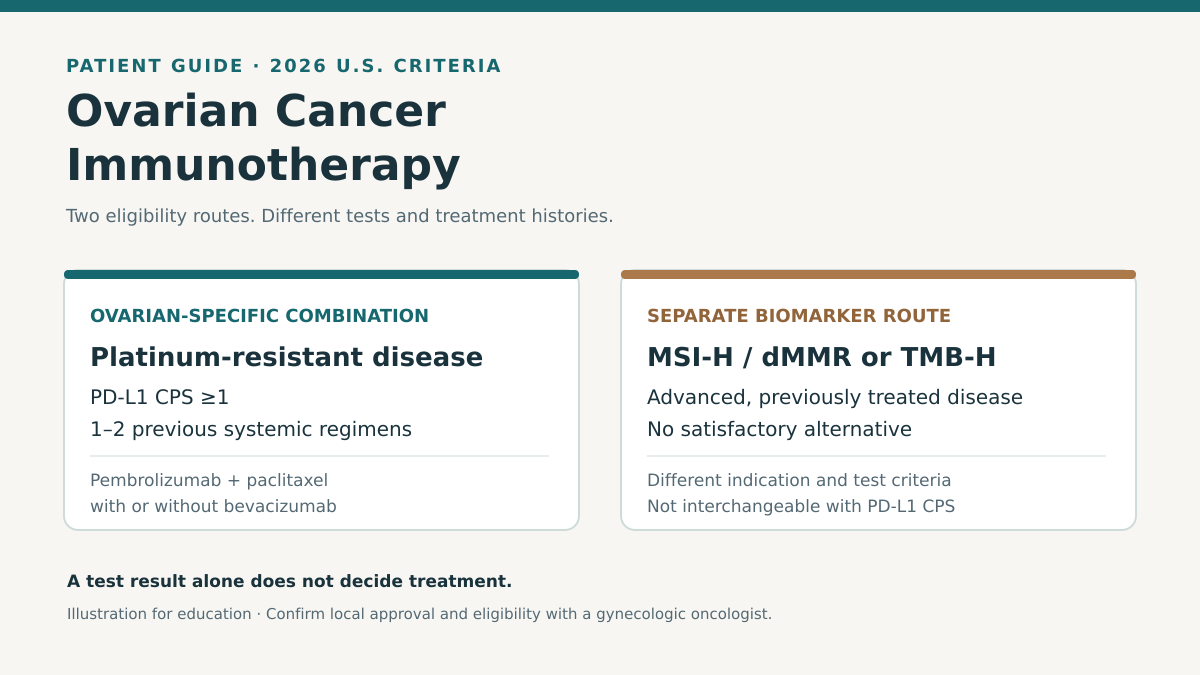
Educational illustration of two different U.S. eligibility routes. A test result alone does not determine treatment.
Who qualifies for the ovarian-specific U.S. regimen?
The FDA approved pembrolizumab (intravenous Keytruda or subcutaneous Keytruda Qlex) with paclitaxel, with or without bevacizumab, on February 10, 2026, for adults with platinum-resistant epithelial ovarian, fallopian tube or primary peritoneal carcinoma, PD-L1 combined positive score (CPS) of at least 1 on an FDA-authorized test, and one or two prior systemic treatment regimens. Platinum-resistant means the disease progressed within six months of platinum treatment in the pivotal trial; a specialist should interpret individual treatment dates and history rather than rely on the label alone. The regimen includes chemotherapy; pembrolizumab alone is not the ovarian-specific combination. [1][2]
In the randomized, double-blind KEYNOTE-B96 trial, 643 patients were enrolled; among 466 with PD-L1 CPS ≥1, median progression-free survival was 8.3 months with pembrolizumab added to paclitaxel (with or without bevacizumab), versus 7.2 months with placebo added to the same backbone. Median overall survival was 18.2 versus 14.0 months. These are group medians in the eligible trial population, not a forecast for an individual or a claim that all PD-L1-positive tumors respond. [1]
What if the tumor has MSI-H/dMMR or TMB-H?
Separate U.S. FDA indications permit single-agent pembrolizumab for unresectable or metastatic solid tumors with MSI-H (high microsatellite instability) or dMMR (deficient mismatch repair), or TMB-H (tumor mutational burden ≥10 mutations per megabase), determined by an FDA-authorized test, after progression on prior treatment and when no satisfactory alternative exists. The TMB-H indication remains an accelerated approval. These are tumor-agnostic routes, not proof that unselected ovarian tumors benefit; the ovarian-specific combination uses PD-L1 CPS, which is a different test and threshold. [2]
Ask the treating gynecologic oncologist whether tumor testing is adequate, whether a result is from the current cancer, and which indication and treatment line are being considered. BRCA mutations or homologous-recombination deficiency can guide other treatments but do not by themselves establish eligibility for pembrolizumab. [2][3]
What has not been established?
Checkpoint inhibitors are not routine treatment for unselected ovarian cancer, especially newly diagnosed disease. In the phase 3 IMagyn050 trial in newly diagnosed advanced ovarian cancer, adding atezolizumab to chemotherapy plus bevacizumab did not significantly improve progression-free survival in the overall population (median 19.5 versus 18.4 months; hazard ratio 0.92, 95% CI 0.79–1.07). That negative result does not cancel the later, different platinum-resistant, biomarker-selected KEYNOTE-B96 finding. [4][1]
Therapeutic vaccines, tumor-infiltrating lymphocytes and NK-cell infusions remain investigational approaches for ovarian cancer; they should not be presented as substitutes for this approved U.S. regimen. [5] The site’s NK-cell overview explains the distinct cell-based approach. The clinic’s listed NK provision plan concerns cancer prevention, not an approved ovarian-cancer treatment, and this article does not claim GINZA NOA CLINIC offers ovarian-cancer therapy.
Mirvetuximab soravtansine is an FDA-approved, folate receptor-alpha-targeted antibody–drug conjugate for selected platinum-resistant disease; it delivers a cell-killing drug and is not a checkpoint inhibitor. PARP inhibitors are targeted drugs, not immunotherapy. These alternatives may be relevant depending on FRα testing, previous regimens and other clinical factors. [3][6]
What risks and next steps matter?
Pembrolizumab can cause serious or fatal immune-mediated effects, including lung, bowel, liver and endocrine inflammation. Paclitaxel and optional bevacizumab add their own risks, so the benefit–harm discussion must cover the whole combination. Patients with autoimmune disease, prior severe immune toxicity or other major conditions need individualized specialist review; do not stop or delay established cancer care to seek an unproven immune-cell procedure. [2]
If you are comparing treatment in Japan with a U.S. option, ask a gynecologic oncology team to review the pathology report, prior platinum dates and regimens, PD-L1 CPS and MSI/MMR or TMB results. U.S. FDA approval does not establish approval, coverage or availability in Japan; Japanese approval and access for this exact regimen have not been confirmed here. See the site’s immunotherapy overview and medical disclaimer for broader context and the limits of this information.
Bottom line: the 2026 U.S. pembrolizumab combination applies to PD-L1 CPS ≥1 platinum-resistant disease after one or two systemic regimens; later-line tumor-agnostic routes depend on different biomarkers and further conditions. Bring the test reports and treatment timeline to your oncology team rather than treating “immunotherapy” as one interchangeable product. [1][2]
Ask about consultation arrangements
An enquiry does not confirm availability of any ovarian cancer drug or treatment. Medical decisions remain with the treating oncologist.
References
- [1] FDA. February 2026 ovarian-cancer pembrolizumab approval and KEYNOTE-B96 results. FDA approval notice.
- [2] FDA. Keytruda prescribing information (2026), sections 1.8, 1.18, 1.21, 5.1 and 14.21. FDA label (PDF).
- [3] National Cancer Institute. Ovarian epithelial, fallopian tube and primary peritoneal cancer treatment (PDQ). NCI professional summary.
- [4] Moore KN et al. IMagyn050 randomized phase 3 primary report, Journal of Clinical Oncology (2021). Original research article.
- [5] National Cancer Institute. Immunotherapy to Treat Cancer (research-stage approaches and approved treatment types). NCI immunotherapy overview.
- [6] FDA. Mirvetuximab soravtansine approval for FRα-positive platinum-resistant epithelial ovarian cancer. FDA approval notice.