
Laboratories test cells for bacterial contamination by taking a sample of the cell preparation and checking whether bacteria grow in culture. For cell-therapy products, conventional sterility culture can take 14 days; a Gram stain or another validated rapid method may support release of a short-shelf-life product while culture continues. Mycoplasma require dedicated testing because routine sterility methods may miss them.Download
This article concerns cells prepared for treatment, not tests used to diagnose a bacterial infection in a patient. Samples may be collected during cell processing and from the finished batch. The exact testing and release strategy depends on the product; these are not three compulsory sequential steps for every cell preparation. Endotoxin testing checks a bacterial substance rather than living bacteria, and viral testing addresses a separate hazard.000273883.pdf This is general information, not personal medical advice.
Why Bacterial Testing Matters
Growing cells outside the body takes days or weeks in warm, nutrient-rich liquids, and bacteria can grow well under the same conditions. Contamination can enter through the starting material, the liquids and reagents added during culture, the equipment, the workspace, or handling during collection, storage, transport, and administration — and each of those entry points is a reason samples are tested at several stages.
In 2018, the Centers for Disease Control and Prevention investigated infections in 12 patients in Texas, Florida, and Arizona after administration of non-FDA-approved umbilical cord blood-derived products. Among patients whose reason for receiving the products was known, the conditions were nonhematopoietic, such as pain or orthopedic conditions. Reported infections included bloodstream infections, joint infections, and epidural abscesses.Mm6750a5.htm All 12 patients were hospitalized, with reported stays of 4 to 58 days; none had died as of 14 December 2018. Organisms included Escherichia coli, Enterobacter cloacae, and Enterococcus faecalis, and contamination in unopened vials indicated that it had occurred before distribution.Mm6750a5.htm This single outbreak does not establish a contamination rate for cell products generally.
The United States Food and Drug Administration warns that unapproved regenerative medicine products can carry bacterial infection risks, including life-threatening bloodstream infections, and that processing can introduce bacteria, viruses, or mold.Important patient and consumer information about regenerative medicine therapies Passing a contamination test does not establish that a treatment is approved or effective.
What “Tested for Bacteria” Covers
Clinic websites sometimes use the phrase “safety tested.” That phrase alone does not tell you which tests were done.
| Check | What it looks for | Why it is separate |
|---|---|---|
| Sterility test | Living bacteria and fungi that can grow in culture media | The main broad screen for bacterial contamination |
| Mycoplasma test | Mycoplasma species, a distinct group of bacteria that need targeted methods | Standard sterility cultures and microscopes can miss them, so a dedicated test is used |
| Endotoxin test | Bacterial endotoxin, a fever-causing substance from certain bacteria | It detects a bacterial substance, not living bacteria, so it cannot replace a sterility test |
| Virus testing | Adventitious viruses in the product; donor infections such as HIV and hepatitis are screened in a separate step | Viruses need different methods and are not detected by bacterial cultures |
The Food and Drug Administration recommends microbiological testing that includes sterility, mycoplasma, and testing for adventitious viruses, alongside identity, purity including endotoxin, viability, and potency.Download Japan’s guidance lists mycoplasma, endotoxin, and sterility testing as standard final-product specifications in principle.000273883.pdf A negative result on one of these checks does not cover the others.
How the Main Tests Work
Growth-Based Sterility Cultures
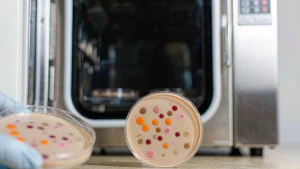
In a growth-based sterility culture, laboratory staff place a sample into suitable nutrient media and incubate it so bacteria or fungi present can multiply to a detectable level. FDA guidance on human somatic cell therapy investigational applications describes conventional sterility testing continued to a full 14-day result, referring to 21 CFR 610.12 and United States Pharmacopeia chapter 71.Download This allows time for slow-growing organisms or a small starting number of microbes to become detectable; a product-specific validated alternative may have a different testing time.
Only part of a batch can be tested, which matters most when the batch is small, such as cells collected from the patient. A negative culture means no growth was detected in that sample under the stated laboratory conditions; it does not mean every cell in the batch was examined.
Antibiotics used during manufacturing can complicate testing because residues left in the sample may suppress microbial growth and hide contamination. Guidance therefore calls for documentation that antibiotics were removed before testing, or for validity checks known as bacteriostasis and fungistasis testing to show that residues do not invalidate the assay.Download
Same-Day and Rapid Checks
While cultures incubate, laboratories also run faster same-day checks. In a Gram stain, staff spread a sample on a slide, apply a series of dyes, and examine it under a microscope on the same day. Bacteria appear purple or pink depending on their cell-wall structure, which can give an early indication of the type of organism. A Gram stain is much less sensitive than a culture because visible detection generally requires a large number of organisms, so a negative stain does not rule out contamination.
A faster result is useful only if the method is suitable for the product and its intended use. FDA guidance calls for validation of alternative testing methods.Download Japan’s consultation guidance likewise says that a rapid test’s detectability must be checked so its limits are understood.000278368.pdf
Dedicated Mycoplasma Testing
Mycoplasma are small bacteria without a cell wall. A culture that looks normal is not a substitute for a dedicated mycoplasma test, and ordinary sterility testing alone may not detect them.Download
Methods include mycoplasma-specific culture, indicator-cell culture, and nucleic-acid amplification testing, which detects genetic material. Japan’s 2016 technical guidance allows a validated nucleic-acid method as an alternative to culture and/or indicator-cell methods. It specifies detection sensitivity of 10 colony-forming units per milliliter for seven mycoplasma species, with sensitivity and specificity confirmed at the testing facility.000273883.pdf This is a method-performance requirement in that guidance, not a universal promise about every clinic’s assay. Species coverage and the validation used for the actual product still matter.
When Test Samples Are Taken
Bacterial testing is not limited to one sample from the finished product. Guidance recommends testing at several stages because a single final sample cannot represent every step.Download
Typical sampling stages include the starting material and cell banks, in-process samples at critical points during extended culture or after steps such as activation or modification of the cells, and the final formulated product.Download When the final product must be given before the full 14-day culture is complete, the Food and Drug Administration’s guidance describes an alternative approach: test an in-process sample taken 48 to 72 hours before final harvest or after the last re-feeding of the cultures, perform a rapid test such as a Gram stain on the final product, and still run the full regulation-compliant sterility culture on the final product to completion.Download Release under this approach rests on the negative rapid result plus the no-growth in-process result, while the final culture continues afterward and any later positive triggers investigation, reporting, and medical evaluation of the patient.Download
Japan’s guidance addresses the same situation: even when final sterility and mycoplasma results will only be available after administration, the tests should still be performed.000278368.pdf The patient must be told in advance, through informed consent, that documented final results are not yet available on the treatment day, and protective measures must be arranged, including prompt treatment if a result turns positive.000273883.pdf Testing an intermediate sample instead of the final product is acceptable only under strict conditions, including well-controlled aseptic processing throughout, testing at the middle step, and a system that reliably rules out contamination in the later steps.000278368.pdf
If cells are prepared into a dosing solution at the treating clinic after shipment, that preparation step needs its own written procedure and staff training, and sterility of the prepared solution should be addressed in the same consent and follow-up framework.
What Test Results Can and Cannot Tell You
A pending result is not a negative result. Before agreeing to treatment, find out which results will be final on the treatment day and which will arrive later.
A negative result means the test did not detect its target in that sample under those conditions. Its meaning depends on sample volume, method sensitivity, and sampling time. It cannot exclude contamination introduced later during storage, transport, or handling at the clinic; those steps need their own controls.
A positive result after administration requires investigation and medical evaluation of the patient, not simply a repeat test to dismiss the finding. The FDA somatic cell therapy guidance describes reporting the investigation and corrective actions within 30 calendar days of the first positive result, and reporting serious, unexpected adverse experiences potentially linked to the sterility failure within 15 calendar days.Download These are sponsor-facing provisions in that US investigational guidance, not universal clinic deadlines or a reason to delay urgent care; the applicable current reporting requirements must also be followed.
Bacterial Testing in Japan’s Framework
Under Japan’s Act on the Safety of Regenerative Medicine, a provision plan includes how cells are obtained and how the processed cells are manufactured and quality-controlled. The plan is submitted after the required committee opinion is obtained.4980 Such treatment-plan filings are not the same as marketing approval of a regenerative medical product. PMDA’s product-development guidance addresses quality testing for products seeking approval under the Pharmaceuticals and Medical Devices Act.000273883.pdf
A plan number alone does not establish efficacy or show that your batch passed its release tests. Ask which framework applies, which facility prepared the cells, and which written release criteria apply to the specific batch.
How to Read a Batch Testing Summary
For example, suppose a summary says the final-product Gram stain is negative but the sterility culture is still incubating. These statements are compatible: one is a completed rapid check, and the other is unfinished. The summary does not yet provide a final negative culture result. FDA guidance describes situations in which a rapid result and in-process culture support release while final-product culture continues.Download
Use that distinction when reviewing your own documents: match the batch identifier to the product intended for you, locate the sampling date and method for each test, and check whether “negative” means a completed result or “no growth to date.” If testing is pending, ask who will receive the final result and contact you if it changes. The hypothetical example above does not establish that release would be appropriate for a particular patient or product.
Bacterial Testing Questions to Ask Before Treatment
Bring these questions to the treating clinician in writing and keep the answers with your records.
- What is the cell source, and does the process include a culture step with added materials?
- Which sterility and mycoplasma tests apply to my batch, and which separate endotoxin and viral checks are required?
- What was sampled, when, and by which method, and will the final results be available before my treatment?
- If any result arrives after treatment, what is the written follow-up plan and who is responsible for it?
- What findings would stop release or postpone my treatment?
- How are batches kept separate and matched to the correct patient?
- Who handles urgent follow-up, and how do I reach them after hours or after returning home?
Have questions about batch testing for your planned treatment?
Bring your test list and sampling dates, and ask what is final before treatment day.
When to Seek Urgent Care
After cell administration, even if earlier bacterial tests were negative, seek immediate medical care for signs of possible serious infection, especially fever with shivering or feeling very cold, shortness of breath, confusion, or extreme pain or discomfort. These can be symptoms of sepsis, a medical emergency.Index Tell the emergency team about the cell product, the administration date, and the treating facility rather than waiting for the clinic to return a message. These symptoms do not by themselves prove the product was contaminated; they require medical assessment.
The Bottom Line
Testing a cell preparation means testing a sample, not inspecting every cell. Culture looks for microbial growth; rapid methods and dedicated mycoplasma tests address specific testing needs. Before treatment, ask for the batch’s test methods, sampling dates, final-or-pending results, and follow-up arrangements. A negative result cannot guarantee that the entire batch is free of contamination.




