
Mycoplasma testing is important because contamination can remain hidden while changing how cultured cells grow and behave. A culture may look normal even with 10 million to 100 million organisms per milliliter, so visual inspection cannot reliably rule it out.Mycoplasmacontam Testing helps protect research results and, when cells are intended for treatment, informs decisions about whether a batch is suitable for use. It does not establish that a treatment is effective.
This article concerns mycoplasma contamination in cell cultures and cell products, not testing a person for a respiratory infection. It provides general information, not personal medical advice.
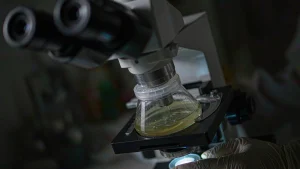
Why Contamination Can Go Unnoticed
Mycoplasmas are bacteria without a rigid cell wall. At roughly 0.2 to 0.3 microns across, they are difficult to detect with routine light microscopy. Contaminated mammalian cell cultures often show no obvious warning signs; early contamination may cause neither a change in the medium’s pH nor significant visible damage to the cells.Mycoplasmacontam
Contamination can spread from infected cell lines during routine handling, including through aerosols generated when transferring culture material. Good aseptic technique reduces opportunities for contamination, but it does not replace testing.Mycoplasmacontam
A 2012 review summarized reports of mycoplasma contamination in approximately 15–35% of laboratory cell cultures worldwide. Those historical figures describe published laboratory-culture surveys, not the current failure rate of clinical cell batches or any particular clinic.PMC3584481
Why It Matters for Cell Quality
Mycoplasma can alter cell growth, inhibit metabolism, disrupt nucleic-acid synthesis, cause chromosome changes, and change cell-surface characteristics. It can also affect how cells respond to transfection or viral exposure.Mycoplasmacontam In research, these effects can distort experimental results and make comparisons between cultures unreliable.PMC3584481
A mycoplasma test answers a contamination question. It is not a cell-identity test, a cell count, or a measure of therapeutic potency. A negative result cannot substitute for those separate assessments.
Why It Matters for Patient Safety
When cultured cells are intended for administration to a patient, contamination becomes a patient-safety concern as well as a laboratory problem. The FDA lists bacterial infections, cross-contamination during processing, and inadequate infectious-disease testing among the risks associated with unapproved regenerative medicine products. Its broader warning also includes reported blindness and tumor formation; those harms should not be attributed specifically to mycoplasma.Important patient and consumer information about regenerative medicine therapies
A US outbreak illustrates the consequences of contaminated cell products, although it did not involve mycoplasma. As of 14 December 2018, the CDC investigation identified 12 patients with infections after receiving bacterially contaminated, unapproved umbilical cord blood–derived products. All were hospitalized, with initial stays of 4–58 days. Bacteria were also recovered from unopened vials, indicating contamination before distribution. The distributor issued a voluntary recall on 28 September 2018.Mm6750a5.htm
This outbreak does not measure mycoplasma risk. It shows why contamination controls matter before a product reaches a patient. A dedicated mycoplasma test addresses a different detection problem from routine checks for other bacteria and fungi.PMC3584481
| Check | What it tells you | Important limit |
|---|---|---|
| Visual inspection | May reveal obvious changes in a culture. | A normal-looking culture does not exclude mycoplasma.Mycoplasmacontam |
| General sterility testing | Assesses microbial growth under the conditions of that test. | Do not assume it includes a dedicated mycoplasma assay.PMC3584481 |
| Mycoplasma testing | Checks specifically for mycoplasma using the selected method. | It does not establish freedom from every other contaminant or prove treatment benefit. |
How Testing Methods Differ
Methods include culture-based detection, polymerase chain reaction (PCR), and DNA staining, sometimes using indicator cells. They detect contamination in different ways and have different limitations. For example, some mycoplasmas grow poorly under particular culture conditions, while interpreting DNA staining requires care.PMC3584481 The useful question is not simply whether a clinic uses a fast test, but whether the laboratory has shown that its method is suitable for the material being tested.
A US regulatory example shows why method choice and the testing requirement are separate issues. In 2020, the FDA removed the prescribed test in 21 CFR 610.30 for live or inactivated virus vaccines produced from living cell cultures. The change took effect on 21 September 2020; mycoplasma testing remained required under the applicable biologics licenses. The rule recognized the availability of more sensitive and specific methods. It was not a blanket rule for every cell-therapy clinic.Revocation of the test for mycoplasma
What This Means in Japan
Japan’s product-approval route and its treatment-plan framework are distinct. The PMDA publishes information and review reports for approved regenerative medical products.0003 The Ministry of Health, Labour and Welfare separately describes procedures for treatment plans, certified committees, and cell-processing facilities under the Act on the Safety of Regenerative Medicine. A treatment-plan filing is not marketing authorization for a product and is not proof of clinical benefit.Index
When discussing a clinic’s registration and compliance, ask separately which testing and release criteria apply to your cells. A plan number does not tell you the result for your batch. Ask where those checks fit into the treatment process.
What a Test Result Does and Does Not Mean
A negative result means mycoplasma was not detected in the tested sample under that assay’s conditions. It is not proof that every part of the batch is free of contamination. Sampling, method performance, and what happens after sampling all matter. Nor does a negative result establish the cells’ identity, potency, or likely benefit for your condition.
Testing only the starting culture leaves a gap if contamination occurs later. Testing later in production can address that gap, but the result must be interpreted alongside the sampling plan and release procedure. There is no single testing schedule in the sources cited here that applies to every research culture, clinical product, or clinic.PMC3584481Revocation of the test for mycoplasma
If a result is positive, inconclusive, or unavailable, ask the responsible clinician and laboratory how the batch is being held and assessed under the applicable release procedure. Do not interpret missing paperwork as a negative result. Routine cell-culture antibiotics are not reliable protection against mycoplasma; their use is not evidence that a batch is clear.Mycoplasmacontam
What to Ask About Your Batch
For a practical cell-treatment safety discussion, ask for a report or written explanation that identifies the batch or sample, the method, the sampling date, the result, and whether the result is final. Then ask who authorizes release. This is a document-checking checklist, not a way to approve a batch yourself.
For example, if a clinic shows you a negative report from an earlier culture stage, ask: “Does this report cover the cells intended for my procedure, and what checks address the processing done after this sample was taken?” If the answer is only “all our cells are tested,” request the batch-specific explanation before deciding whether to proceed.
| Question | What to clarify |
|---|---|
| Which test covers my batch? | Ask for the named mycoplasma method and how the sample identifier connects to your cells. |
| When was the sample taken? | Ask which production stage it represents and whether further culture or handling occurred afterward. |
| When is the final result available? | If it will not be available before the procedure, ask the clinician to explain the applicable release procedure and remaining uncertainty. |
| Who performs and reviews the test? | Identify the laboratory, whether it is at the cell-processing facility or external, and who is responsible for the release decision. |
| What happens after a positive or unclear result? | Request the written policy for holding the batch, investigating the result, changing the treatment date, and handling repeat-work costs. |
| What other checks apply? | Ask about other microbial tests and any applicable donor screening. US donor-testing rules separately address listed communicable-disease agents; they are not a mycoplasma-testing rule.Section 1271.80 |
If the explanation remains unclear, seek an independent medical opinion before committing to treatment. The ability to explain batch testing is one issue to consider when evaluating a cell-treatment provider, not proof that the proposed treatment is appropriate.
Comparing clinics in Japan? Send your testing questions through the inquiry form and ask how your batch would be handled.
Bottom Line
Mycoplasma testing matters because a normal-looking culture can contain 10 million to 100 million organisms per milliliter while the contaminant alters the cells.Mycoplasmacontam For research, that threatens the reliability of results. For cells intended for patients, testing contributes to contamination control and the release decision. Ask which report covers your batch, when the sample was taken, and how the result is used. A negative test is neither a guarantee of safety nor evidence that the treatment works.




