
Endotoxin testing measures the activity of bacterial endotoxin in a sample, usually reported in Endotoxin Units per milliliter (EU/mL). It detects endotoxin rather than counting living bacteria. Laboratories use the result to assess whether the tested material meets its endotoxin specification; that is separate from proving sterility or clinical safety.Pyrogen and endotoxins testing questions and answers
A quantitative test reports an activity level. A limit test can instead show whether endotoxin is detectable at a specified test threshold. To interpret either result, you need the reporting units, the applicable product limit, and a valid method.
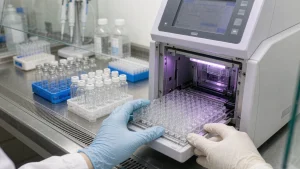
What the Test Detects
Endotoxin is lipopolysaccharide associated with the outer membrane of Gram-negative bacteria. It can remain after the bacteria have died, so a sample can contain endotoxin even when no living bacteria are detected. The bacterial endotoxins test measures the sample’s reaction relative to an endotoxin reference standard, not the number of bacterial cells or a fixed mass of toxin.Download
This is a product-quality test, not a test that diagnoses the cause of a patient’s fever. Its result applies to the sampled material under the validated test conditions.
What EU Means
One EU equals one International Unit (IU) of endotoxin activity. EU measures activity relative to a reference standard, so it should not be treated as a universal conversion to nanograms.Download
| Report entry | What it describes |
|---|---|
| EU/mL | Endotoxin activity per milliliter of the reported liquid sample |
| EU/device | Endotoxin activity attributed to a device through the specified extraction procedure |
| EU per dose | Activity in the amount administered, calculated from the concentration and dose |
| Less than a stated value | A result below the stated reporting threshold, not proof of zero endotoxin |
For an extract or a diluted sample, ask whether the reported result has already been converted to the original product basis. A concentration in an extract is not automatically the same as the total activity per device.
How the Limit Is Set
For many parenteral drugs, the dose-based calculation is endotoxin limit = K/M. In FDA’s historical inspection guide, K is 5.0 EU/kg, an approximate threshold pyrogen dose, or 0.2 EU/kg for intrathecal administration into spinal fluid. The latter is 25-fold lower. These are calculation inputs, not universal concentration limits or guarantees that an individual will not develop a reaction.Bacterial endotoxinspyrogens
A Dose-Based Example
For a hypothetical non-intrathecal drug with a maximum human dose of 10 mL/kg within one hour, using K = 5.0 EU/kg gives 5.0 ÷ 10 = 0.5 EU/mL. This reproduces the arithmetic in FDA’s inspection guide; it is not a limit for an unspecified cell product.Bacterial endotoxinspyrogens
The actual specification must match the product, route, and maximum dose. FDA’s current guidance warns that older limit tables and even monograph limits may need checking against current strengths and dose regimens; intrathecal, ophthalmic, and device limits require particular attention.Pyrogen and endotoxins testing questions and answers
For example, FDA recommends a release limit of ≤0.2 EU/mL for ophthalmic viscosurgical devices (OVDs) and ≤0.2 EU/device for the anterior-segment solid intraocular devices covered by its guidance. These recommendations do not apply to every intraocular fluid or to cell therapies.Download
How Laboratories Detect Endotoxin
Traditional testing uses Limulus amebocyte lysate (LAL), derived from horseshoe crab blood cells. The principal compendial techniques are gel-clot, turbidimetric, and chromogenic testing. USP <85>, European Pharmacopoeia 2.6.14, and Japanese Pharmacopoeia 4.01 are addressed by ICH Q4B Annex 14, which permits interchangeability subject to its conditions rather than unconditional substitution.Download
| Technique | Observed signal | How to read it |
|---|---|---|
| Gel-clot | Formation of a firm gel | Often used to establish whether a specified threshold is met, rather than produce a precise concentration |
| Turbidimetric | Change in cloudiness | Compared with standards to determine endotoxin activity |
| Chromogenic | Color generated by the reagent reaction | Compared with standards to determine endotoxin activity |
Recombinant assays, including recombinant Factor C approaches, provide non-animal-derived alternatives. FDA’s March 2026 update accommodates a broader range of recombinant reagents and discusses USP <86>. The laboratory still needs to verify suitability for the specific material and intended use; changing reagents does not remove that obligation.Fda clarifies current thinking pyrogen and endotoxins testing
Why Sample Controls Matter
A product can inhibit or enhance the reaction. Sample preparation, storage, mixing, and dilution can also affect detection. Laboratories need suitable controls and a validated procedure; dilution must not exceed the maximum valid dilution and make a failing concentration undetectable. Uneven contamination or contamination introduced after sampling may not be represented by the tested portion.Pyrogen and endotoxins testing questions and answers
What a Passing Result Does Not Prove
| Separate question | What is needed beyond endotoxin testing |
|---|---|
| Are living bacteria or fungi present? | Sterility testing and appropriate microbial controls |
| Is mycoplasma present? | Dedicated testing where relevant, especially for cultured cells |
| Are viruses present? | Relevant screening, material controls, and virus-specific assessments |
| Are non-endotoxin pyrogens present? | A broader pyrogen assessment using an appropriate validated method |
| Will a cell treatment work? | Product characterization and clinical evidence for that exact use |
Endotoxin is only one type of pyrogen, a substance capable of causing fever. FDA distinguishes endotoxin assays from broader pyrogen tests and discusses alternatives such as monocyte activation testing on a case-by-case basis. A low endotoxin result does not exclude every fever-causing substance.Pyrogen and endotoxins testing questions and answers
Routine sterilization is not the same as depyrogenation. Killing or filtering out bacteria does not necessarily remove their endotoxin, which explains why sterility and endotoxin testing answer different questions.Bacterial endotoxinspyrogens For cell preparations, cell processing controls and other release checks remain relevant even when endotoxin meets its specification.
How to Read an Endotoxin Report
Start with the product and batch identifier, the method, the result and units, the specification, and the reporting threshold. Check that the result and limit use the same basis and that the laboratory considers the run valid.
A Hypothetical Report
Suppose a report states <0.05 EU/mL against a specification of ≤0.5 EU/mL. If both values refer to the original product and the method and controls are valid, the reported result is below that endotoxin limit. It does not mean zero endotoxin, prove sterility, or predict benefit. These numbers illustrate report interpretation; they are not a patient case or a recommended product limit.
- Does the result cover the batch intended for use and the relevant sampling point?
- Was interference assessed for this product, and has dilution been accounted for?
- Is the specification appropriate for the planned dose and administration route?
- Which companion tests are complete, which are pending, and who authorizes release?
- What is the documented response if a result fails?
For a cell treatment planned in Japan, ask for those answers before administration. Assessing treatment safety also requires evidence matched to the diagnosis, eligibility, cell type, and route, not just a passing laboratory result.
A Japanese regenerative medicine provision-plan filing is not proof of efficacy. MHLW explicitly states that the filed interventions in its report have not been confirmed by the ministry to be effective and safe. Filing, product-quality testing, and evidence of clinical benefit are separate matters.001713675.pdf
If fever, chills, or other concerning symptoms develop after an injection or infusion, seek prompt medical advice regardless of a previous test result. This article provides general information, not personal medical advice.
Need help preparing questions for the clinic?
Ask the patient support team about coordinating an enquiry. Start with a general question; do not send identifiable medical records before confirming the recipient and transfer arrangements. Support is not a medical consultation or laboratory release decision.
References
- FDA: Pyrogen and Endotoxins Testing: Questions and Answers, Edition 2. March 2026; United States. Accessed November 6, 2026.
- FDA: Endotoxin Testing Recommendations for Single-Use Intraocular Ophthalmic Devices. Definitions and device-specific recommendations; United States. Accessed November 6, 2026.
- FDA: Bacterial Endotoxins/Pyrogens, Inspection Technical Guide No. 40. Historical guide dated March 20, 1985; used here for the dose calculation and sterility distinction, not current reagent policy. United States. Accessed November 6, 2026.
- FDA: ICH Q4B Annex 14, Bacterial Endotoxins Test General Chapter. October 2013; conditional pharmacopoeial interchangeability in ICH regions. Accessed November 6, 2026.
- FDA: Clarifies Current Thinking on Pyrogen and Endotoxins Testing. March 18, 2026; recombinant reagents and product suitability, United States. Accessed November 6, 2026.
- MHLW: Overview of Periodic Reports on the Provision of Regenerative Medicine. June 22, 2026, material 1 for the 118th evaluation meeting; Japan. See the caution about filed interventions in the analysis-method section. Accessed November 6, 2026.




