
Some are, but not all. Ultrasound can guide a needle into a local target, such as a joint; whether it is used depends on the procedure and the treatment protocol. Ultrasound uses sound waves to produce images and can help guide needles. It is a placement tool, not proof that a cell treatment works. Sonogram Important patient and consumer information about regenerative medicine therapies
This article is general information, not medical advice for your case. Discuss a proposed treatment with your own doctor before changing care, paying, or traveling.
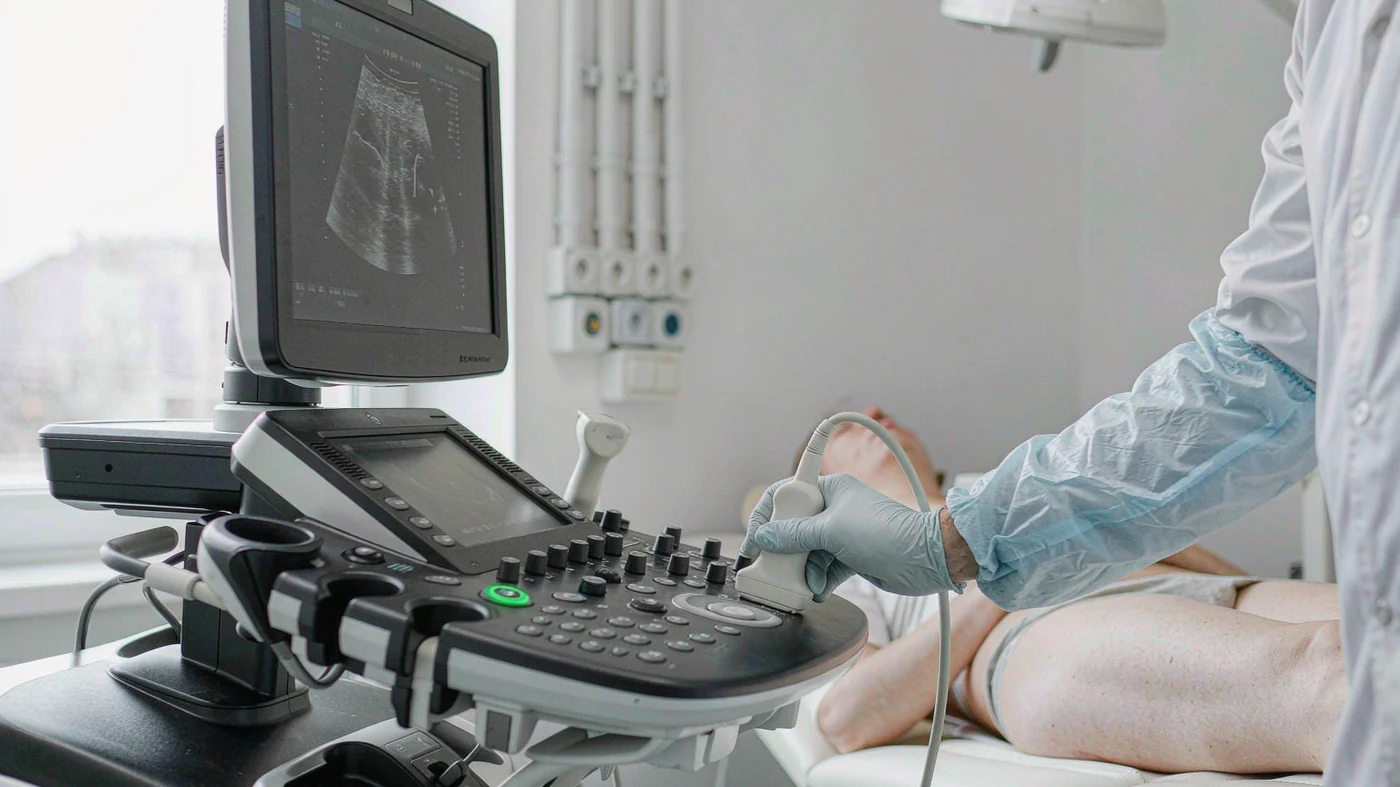
What ultrasound guidance means
Ultrasound creates images of tissues inside the body without ionizing radiation. A clinician moves a probe over the skin to view the area being examined. During a guided needle procedure, imaging helps the clinician locate the target and guide the needle toward it. MedlinePlus describes this principle for needle biopsies; that explanation is about imaging, not evidence for stem cell treatment. Sonogram
Seeing the needle and target does not establish cell viability, product quality, an appropriate dose, or a likely clinical benefit.
Check the route before the imaging
Ask for the exact destination of the proposed injection. “Stem cell injection” alone does not tell you whether cells would enter a joint, another local tissue, a vein, or spinal fluid. The questions below help you clarify an offer; they are not a treatment recommendation or a survey of how often each imaging method is used.
| Proposed route | What to clarify | Question to ask |
|---|---|---|
| Injection into a joint | The named joint and the planned guidance method | Will you use ultrasound, another imaging method, or anatomical landmarks? Why is that suitable for my case? |
| Injection into or around a tendon or ligament | The exact tissue and intended location | Which tissue layer is the target, and how will you assess needle placement? |
| Intravenous infusion | Vascular access versus local tissue targeting | If ultrasound is mentioned, is it for placing the IV line rather than injecting into a joint? |
| Spinal or intrathecal procedure | The exact route, rather than the vague label “spinal injection” | Where will the product go, what guidance is planned, and what evidence supports this specific route? |
| Fat or bone marrow collection | Collection versus subsequent administration | Does the imaging plan describe collection, delivery, or both? |
A documented ultrasound-guided protocol
ClinicalTrials.gov record NCT03866330 provides a concrete example. Sponsored by the Medical University of Warsaw in Poland, the phase I/II protocol planned to enroll an estimated 100 people with mild to moderate osteoarthritis of the knee, hip, or glenohumeral joint, which is the shoulder joint. It specified ultrasound-guided injection into the joint of at least 10 million Wharton’s jelly-derived mesenchymal stem cells per procedure. NCT03866330
The protocol description specified dosing every three months for 12 months, with a maximum of four doses and at least 40 million cells in total. It described follow-up during treatment and for 24 months after the last injection, including clinical assessments, laboratory tests, MRI, and local and systemic safety assessments. These are the study’s stated plans, not a dosing recommendation. NCT03866330
The record was first posted on 7 March 2019. In the record checked on 10 November 2026, its status was “Unknown” and no results were posted. It therefore documents a planned use of ultrasound, not a demonstrated improvement in pain, function, or safety. It does not establish how commonly other clinics use guidance. NCT03866330 A study’s registration is not proof that its treatment works. Clinicaltrials.gov
Ultrasound, fluoroscopy, and landmarks
Ultrasound
Ultrasound uses sound waves rather than X-rays. It can show soft tissues and guide a needle toward a target. The clinician should explain what will be visible during your proposed procedure. Sonogram
Fluoroscopy
Fluoroscopy produces a continuous X-ray image that can show movement of instruments or contrast material. Unlike ultrasound, it involves ionizing radiation. Ask why it is proposed and how its benefits and radiation risks apply to your procedure. The FDA advises discussing these benefits and risks with the treating clinician. Fluoroscopy
Landmark technique
A landmark-based technique relies on anatomy and examination rather than live imaging. If this is proposed, ask how the clinician will assess placement and why imaging is not planned. The absence of ultrasound alone does not answer whether the treatment is appropriate.
A consultation example
Suppose an offer says “ultrasound-guided stem cell injection for knee pain.” Before booking, ask the clinician to name the diagnosis, product, and exact injection site. For a proposed knee joint injection, ask whether ultrasound will guide the needle during delivery or whether the offer only includes a separate diagnostic scan.
Then request a procedure record describing the route, guidance method, and product batch. Compare the proposed product and route with the cited study rather than assuming that the word “ultrasound” makes the treatments equivalent. This is an illustrative consultation scenario, not a patient case or a report of clinical experience.
Guidance is not evidence of benefit
A treatment claim needs evidence for the particular disease, cell type, dose, and route. When a clinic cites a paper, check the population, comparison group, outcomes, follow-up, and adverse events. PubMed indexing alone is not a quality rating. The Warsaw registry example above has no posted results, so it cannot answer whether recipients improved. NCT03866330
Ask for the actual study, not just a testimonial or a picture of an ultrasound machine. If the clinic cannot provide supporting evidence, treat the benefit claim as unsubstantiated.
Approval, research, and clinic services
Blood stem cell transplantation is an established specialist treatment for selected cancers and blood disorders. It is not interchangeable with a private-clinic injection offered for joint pain or aging. Stem cell transplant
In the United States, the FDA warns that regenerative medicine therapies have not been approved for orthopedic conditions such as osteoarthritis, or for chronic pain or fatigue. Its consumer warning also addresses unapproved uses for Alzheimer’s and Parkinson’s disease. Whether a needle is guided does not change the product’s approval status. Important patient and consumer information about regenerative medicine therapies
Japan has a separate regulatory framework. PMDA publishes information about approved regenerative medical products. Check the specific product and indication rather than assuming all cell treatments share the same status. 0003 The Act on the Safety of Regenerative Medicine also provides a framework for provision plans and certified committee review. A filed plan under that framework is not product approval or proof of clinical benefit. Index
Risks imaging does not remove
Imaging does not establish that a cell product is safe. The FDA reports serious harms from unapproved regenerative products, including infections, tumor formation, and unwanted inflammatory or immune responses. These reports are not a complication rate for every cell product or every guided injection. Important patient and consumer information about regenerative medicine therapies
Ask the treating clinician to explain procedure-specific risks, product-related risks, and who will manage complications after you return home. Review the proposed treatment process, including follow-up arrangements, before making travel plans. Do not stop prescribed treatment or delay necessary care while waiting for an injection without discussing it with your own doctor.
What to ask before agreeing
- What is my diagnosis, and what exact product, cell source, dose, and preparation are proposed?
- Where will the product go, and what guidance method will be used?
- Is ultrasound used during injection, for IV access, or only for a separate scan?
- Who performs the procedure, and what training do they have in that route and guidance method?
- Is this an approved product for my condition, a research intervention, or a filed clinic service? What identifier can I check?
- Which study supports this use, and how closely does it match my diagnosis, product, and route?
- What risks, aftercare, follow-up costs, and complication arrangements apply?
- Will I receive the procedure note and product batch details?
Still unsure whether a proposed injection needs imaging?
Bring your diagnosis, imaging report, and the exact product or plan name. The support team can help you organize the questions above before you decide.
Contact the patient support teamBottom line
Stem cell injections can be ultrasound-guided, but the label alone does not tell you whether yours will be. Ask for the exact route and written guidance plan. Then check the product’s legal status and the evidence for your condition separately: accurate placement is not proof of benefit.




