
Stem cell treatment results are measured by comparing condition-specific outcomes before treatment and at planned follow-up visits. These may include pain scores, walking ability, blood tests, or scans. For example, pain can be recorded on a 0–10 scale [1]. Teams track side effects separately, using a defined grading system where appropriate [2]. The key questions are how much changed, whether the change matters to the patient, and how long it lasts. A before-and-after improvement alone does not establish that the treatment caused it.
This is general information, not an individual treatment recommendation. The right measures depend on the diagnosis, cell product, route of administration, and purpose of treatment; there is no single stem cell “success test.”
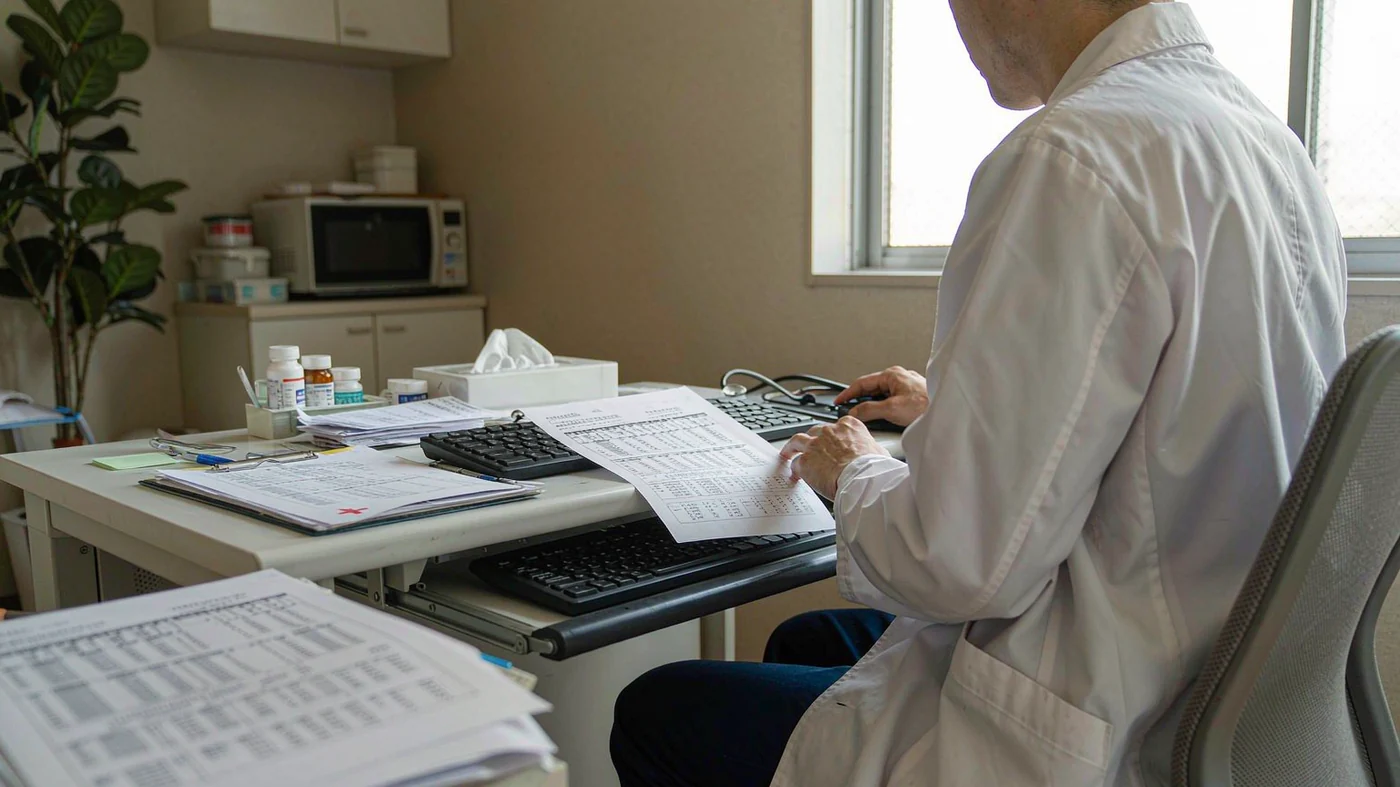
What counts as a treatment result
- Benefit: a change in symptoms, daily function, or a disease-specific outcome.
- Safety: adverse events, their severity, the care required, and whether they resolve.
- Durability: whether an improvement persists at later assessments.
An early reduction in knee pain is an observation worth recording, not proof of lasting benefit. Later pain scores, walking ability, and medication use help interpret it. The follow-up schedule should be chosen for the condition and treatment, rather than treating a fixed number of months as a universal pass mark.
Regulatory approval is also product- and indication-specific, not an endorsement of stem cells as a whole [3]. For example, the FDA approved Ryoncil, a donor bone-marrow-derived mesenchymal stromal cell therapy, on December 18, 2024, for steroid-refractory acute graft-versus-host disease in children aged 2 months and older [4]. That approval does not establish benefit for knee pain or unrelated uses. Approved treatments, experimental interventions in trials, and privately offered clinic services must be assessed separately.
Record a baseline before treatment
The baseline is the starting assessment taken before the intervention being evaluated, not during later follow-up. Keep a record of:
- The diagnosis, severity, and other health conditions.
- Current symptoms, medications, rehabilitation, and activity level.
- Starting symptom and function scores, with the instrument name and version.
- Relevant examination findings, laboratory values, and imaging reports.
The same measures are then repeated at follow-up. The treatment process in Japan provides service-level context for consultation, treatment planning, and follow-up discussions; the clinical team should confirm your actual measurement plan.
Measurement at a glance
| Outcome | Example measure | How to interpret it |
|---|---|---|
| Symptoms | 0–10 numeric pain rating: 0 is no pain and 10 is the most intense pain imaginable [1] | Compare the same question and recall period at baseline and follow-up. |
| Daily function | Timed walking, joint range of motion, or a condition-specific function scale | Use consistent test conditions and record changes in other care. |
| Disease activity or recovery | Diagnosis-specific blood tests or imaging | Interpret alongside symptoms and function; a marker is not automatically a patient benefit. |
| Safety | Adverse-event descriptions and severity grades | Track onset, duration, action taken, and outcome; assess possible causality separately [2]. |
| Durability | Repeated outcomes and dates of major events | Report the duration of observation and who is missing from follow-up. |
Symptoms reported by the patient
Patient-reported outcomes come directly from the patient rather than an examiner’s interpretation. Using a consistent questionnaire makes changes easier to track. The FDA has industry guidance on developing and using these measures to support medical-product labeling claims [5].
The numeric pain rating scale has 11 possible scores, from 0 to 10. A specified recall period, such as the last 24 hours, helps make repeat answers comparable [1]. Depending on the condition, questionnaires may also cover stiffness, fatigue, sleep, self-care, or quality of life.
Ask which change the team considers meaningful for the instrument and patient group. A small numerical difference is not automatically an improvement you would notice in daily life. Also distinguish a change that matters clinically from a statistically significant difference between study groups.
Function and performance tests
Function tests check what you can do, alongside how you feel. Examples include:
- Walking tests: distance covered in a set time, or time needed for a set distance.
- Joint assessments: range of motion, strength, swelling, and stability.
- Condition-specific assessments: appropriate exercise-capacity or neurological function tests.
Keep the testing protocol and instructions consistent. Record walking aids, pain medication taken before the test, and changes in rehabilitation. Do not stop prescribed medication or push through unsafe symptoms to make a test comparable; ask the team how to document the difference.
Blood tests and imaging
A scan or laboratory result addresses a specific question. A joint scan assesses structure; blood counts assess blood-cell recovery; other tests may assess organ function. Ask what the test is intended to show and whether its change corresponds to a benefit that matters to you.
Blood-forming stem cell transplantation has a different purpose from many cell injections offered for other conditions. NCI describes transplantation as restoring blood-forming cells after treatment that damages them, and explains its risks and prolonged recovery. Graft-versus-host disease is a concern with donor transplants, not a universal endpoint for every stem cell procedure [6]. Measures relevant to transplantation should not be presented as evidence that an unrelated joint injection works.
Cell quality is not a patient outcome
A potency assay evaluates biological activity of a cell product. FDA guidance explains that potency testing is product-specific; there is no universal assay for all cellular products [7].
A cell count, viability percentage, or batch certificate is not a measurement of your pain, mobility, or disease control. Product-quality information and clinical-outcome evidence answer different questions; neither should be substituted for the other.
When should results be checked?
Agree on the assessment schedule before treatment. Early visits may focus on procedure-related problems; later visits assess symptom changes, function, and durability. The timing depends on the treatment and condition. There is no universal date when all stem cell treatments should “start working.”
A report should give actual follow-up duration and the number assessed at each visit. Missing patients may differ from those who return. Ask how missing results were handled rather than assuming the available scores represent everyone who started.
How side effects are measured
Record what happened, when it began, how severe it was, whether it required treatment or hospitalization, and the outcome. Severity and seriousness are different: a severity grade describes intensity, while seriousness concerns outcomes such as hospitalization or a threat to life.
One framework used in clinical trials is NCI’s Common Terminology Criteria for Adverse Events (CTCAE). Its general grades are 1, mild; 2, moderate; 3, severe or medically significant but not immediately life-threatening; 4, life-threatening consequences requiring urgent intervention; and 5, death related to the adverse event. Criteria are event-specific, and not every grade applies to every event [2].
An adverse event is not automatically caused by treatment. The team should document events and assess possible causes separately; a Grade 5 event does not by itself establish a treatment-caused death [2].
When to seek urgent care
For chest pain, breathing difficulty, loss of consciousness, sudden severe pain, or other emergency symptoms, seek emergency care immediately using the emergency number for your location. Do not wait for a routine clinic reply [8]. Report fever, increasing injection-site redness, swelling, or other new symptoms promptly to the treating team, and follow the discharge instructions. The site’s Japan stem cell safety information is a service-information entry point, not a substitute for urgent assessment.
Improvement versus proof of efficacy
A patient’s improvement can be real without establishing what caused it. Rehabilitation, medication changes, natural fluctuations, and recovery from the procedure can affect before-and-after scores. Symptoms may also move back toward their usual level after an unusually bad period, a pattern called regression to the mean.
To judge a treatment effect, look for an appropriate comparison group, outcomes specified in advance, and methods that reduce bias, including blinding where feasible. A trial’s registration is not a favorable result or proof of efficacy; read the actual study findings and limitations [9].
Questions behind a success rate
- How was success defined, and was that definition set before results were analyzed?
- How many patients started, completed follow-up, and met that definition?
- Did they match your diagnosis and severity, and receive the same cell product, dose, and route?
- What was the comparison, and how large was the difference in absolute terms?
- How long were patients followed, and how were missing results handled?
- What adverse events occurred, including serious ones?
Japan filing is not efficacy approval
Under Japan’s Act on the Safety of Regenerative Medicine, institutions within its scope must obtain a certified committee’s opinion and submit a provision plan to the health minister before providing the planned regenerative medicine. Article 4 sets out these requirements [10]. Marketed regenerative medical products follow a separate regulatory route involving PMDA review [11].
A filed plan is not product approval and does not by itself demonstrate efficacy. Ask for the applicable regulatory route and human evidence for the exact intervention. The site’s registration and compliance guide helps identify the service information to request; independent evidence is still needed to assess benefit.
A practical follow-up scenario
Suppose you are preparing for a follow-up visit after a knee procedure. Bring the original pain questionnaire and ask to use the same recall period. Note whether your walking aid, medication, or rehabilitation has changed. If you report less pain but still cannot manage stairs, record both findings rather than reducing the visit to “better” or “not better.” This is an illustrative preparation scenario, not a patient case or an account of treatment success.
Before leaving, request a copy of the results and the next assessment date. Ask: “Which change matters for my condition, and what else could explain it?” This makes the discussion more useful without implying that you can establish efficacy from your own records alone.
Keep a usable treatment record
- Baseline scores and dated repeat results using the same instruments.
- The treatment date, cell product or preparation, dose, route, and provider.
- Laboratory and imaging reports, with units and reference ranges.
- Medication, rehabilitation, and activity changes.
- Adverse events, care received, and whether symptoms resolved.
Not sure what to ask at your visit?
Bring your baseline scores and the checklist above, and ask the clinic team to walk through each measure for your condition.
Contact the Patient Support TeamBottom line
Useful results show the starting point, the size of change, harms, and follow-up duration. The clinical team should explain which findings matter for your condition and what remains uncertain. Your records can document your progress; well-designed studies are needed to judge whether a treatment produces benefit beyond other explanations.
Before deciding, ask for the exact outcome measure, the comparison, the follow-up period, and the harms—not just a testimonial or cell count.
References
- Shirley Ryan AbilityLab, RehabMeasures Database. Numeric Pain Rating Scale. https://www.sralab.org/rehabilitation-measures/numeric-pain-rating-scale — Accessed 12 Nov 2026. United States; 11-point 0–10 scale, 0 no pain, 10 most intense pain imaginable, last-24-hour recall.
- National Cancer Institute. Common Terminology Criteria for Adverse Events (CTCAE), v6.0, published 22 July 2025, introduction, page 2. CTCAE v6.0 — Accessed 12 Nov 2026. United States; event-specific severity grading, not proof of treatment causality.
- U.S. Food and Drug Administration. Approved Cellular and Gene Therapy Products. https://www.fda.gov/vaccines-blood-biologics/cellular-gene-therapy-products/approved-cellular-and-gene-therapy-products — Accessed 12 Nov 2026. United States; each listing applies to its own approved product and use.
- U.S. Food and Drug Administration. FDA Approves First Mesenchymal Stromal Cell Therapy to Treat Steroid-refractory Acute Graft-versus-host Disease (press announcement, 18 Dec 2024). https://www.fda.gov/news-events/press-announcements/fda-approves-first-mesenchymal-stromal-cell-therapy-treat-steroid-refractory-acute-graft-versus-host — Accessed 12 Nov 2026. United States; Ryoncil for SR-aGVHD in pediatric patients 2 months and older; first FDA-approved MSC therapy.
- U.S. Food and Drug Administration. Patient-Reported Outcome Measures: Use in Medical Product Development to Support Labeling Claims (final guidance for industry, December 2009, Docket FDA-2006-D-0362). https://www.fda.gov/regulatory-information/search-fda-guidance-documents/patient-reported-outcome-measures-use-medical-product-development-support-labeling-claims — Accessed 12 Nov 2026. United States; industry guidance on developing and using PRO measures when product claims are involved; framework only, not a trial result.
- National Cancer Institute. Stem Cell Transplants in Cancer Treatment. https://www.cancer.gov/about-cancer/treatment/types/stem-cell-transplant — Accessed 12 Nov 2026. United States; transplant-specific endpoints and follow-up context.
- U.S. Food and Drug Administration. Potency Tests for Cellular and Gene Therapy Products (guidance landing page). https://www.fda.gov/regulatory-information/search-fda-guidance-documents/potency-tests-cellular-and-gene-therapy-products — Accessed 12 Nov 2026. United States; potency assays are product-specific; no universal test.
- MedlinePlus, U.S. National Library of Medicine. Recognizing medical emergencies. Recognizing medical emergencies — Accessed 12 Nov 2026. United States; emergency warning signs and seeking emergency assistance. Use the emergency number for your location.
- ClinicalTrials.gov. Learn About Clinical Studies. https://clinicaltrials.gov/study-basics/learn-about-clinical-studies — Accessed 12 Nov 2026. United States; registry records describe design and status; registration alone does not establish efficacy.
- Japanese Law Translation, Ministry of Justice, Japan. Act on the Safety of Regenerative Medicine, Article 4(1)–(3). Act on the Safety of Regenerative Medicine — Accessed 12 Nov 2026. Japan; prior provision-plan submission and certified-committee opinion. English translation is a reference; the Japanese law is authoritative.
- Pharmaceuticals and Medical Devices Agency (Japan). Regenerative Medical Products. https://www.pmda.go.jp/english/review-services/reviews/0003.html — Accessed 12 Nov 2026. Japan; separate product-approval route from institutional practice filings.
General information only. Discuss individual assessment plans and treatment decisions with the responsible clinical team.




