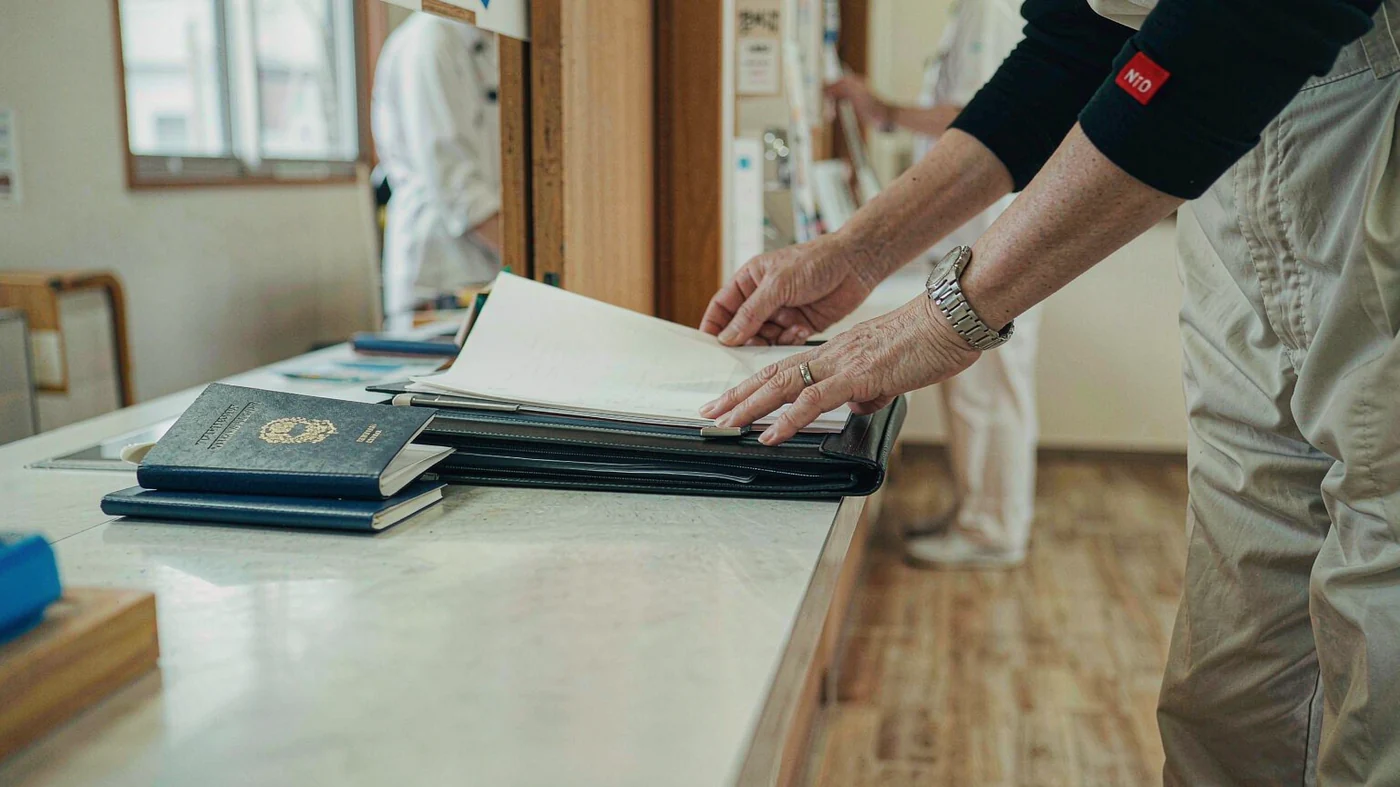
Yes. In Japan, a caregiver may receive a Medical Stay Visa as an accompanying person when needed to provide personal care to a patient. Relatives and non-relatives can qualify, but this is not a visa for paid caregiving work. The arrangement goes through a registered guarantor, and approval is not automatic. [1]
This article covers Japan’s Medical Stay Visa framework, not other countries’ caregiver visas. Requirements depend on nationality and individual circumstances. Confirm your documents and permitted stay with the Japanese embassy or consulate handling your application. This is general information, not immigration or medical advice.
Who Can Accompany the Patient?
Japan’s Ministry of Foreign Affairs (MOFA) allows family members and non-family members to accompany a patient when necessary. The purpose is personal care, not earning income. A spouse, adult child, friend, or other unpaid helper may therefore be considered; the relationship alone does not establish eligibility. [1]
Discuss the need with the registered guarantor arranging the patient’s visit. When accompaniment is agreed to be necessary, the caregiver’s name and details must appear in the combined medical-institution certificate and guarantor reference document. Being named does not replace the embassy’s visa decision. [2]
Can Two Caregivers Apply?
MOFA describes accompanying persons according to need; its guidance cited here does not set a universal one-person limit or a special two-person exception. If two people are needed, explain each person’s role to the guarantor and confirm how each should be recorded and apply. Do not assume that one accepted companion means another will also qualify. [1][2]
Can a Paid Nurse or Caregiver Use This Visa?
Not for paid caregiving activity in Japan. MOFA’s guidance expressly covers private doctors, nurses, dedicated caregivers, counselors, and domestic workers: payment for services performed in Japan counts as remunerated activity even if the payer or payment is outside Japan. Ask the embassy or consulate about unclear payment arrangements before applying. [2]
An unpaid family companion and a hired nurse are therefore different cases. Describe the actual duties and any compensation honestly; do not label a paid professional as an unpaid companion.
How Long Can the Caregiver Stay?
MOFA says accompanying persons may receive the same visa as the patient when necessary. It lists periods of stay of 90 days, 6 months, or 1 year, determined by the patient’s condition and other factors. These are possible periods, not a choice or a guaranteed entitlement for every caregiver. [1]
Travel plan
What to confirm
One medical visit
Check the visa issued and the period of stay permitted for each traveler.
Repeated medical visits
Multiple-entry visas are possible only for visits of 90 days or less. Obtain the doctor’s Medical Treatment Plan through the guarantor. Validity may be up to 3 years; it does not permit continuous residence for 3 years.
A patient stay exceeding 90 days
Hospitalization is a prerequisite. The patient needs a Certificate of Eligibility; confirm the accompanying person’s long-stay requirements separately.
These conditions distinguish multiple-entry validity from the length of an individual stay. For a patient staying beyond 90 days, MOFA identifies staff at the admitting medical institution or the patient’s family living in Japan as the route for obtaining the patient’s Certificate of Eligibility. Guarantor staff cannot act as the proxy for that application. [1][2]
How Does a Caregiver Apply?
Contact a guarantor registered for the Medical Stay Visa scheme to arrange the patient’s medical visit.
Explain who will accompany the patient, what personal care is needed, the proposed dates, and whether any payment is involved.
Have the guarantor coordinate with the receiving medical institution and obtain the combined certificate with the accompanying person’s details. Obtain a treatment plan or arrange the patient’s Certificate of Eligibility when applicable.
Submit each traveler’s required visa documents to the responsible Japanese embassy or consulate.
This follows MOFA’s guarantor-led process. Hospital acceptance and preparation of the certificate are steps in an application, not confirmation that a visa has been granted. [1][2]
Which Documents Does the Caregiver Need?
MOFA’s English checklist lists eight document categories, (A) through (H), for patients, but directs accompanying persons to submit (A) through (C) and (F). The financial and identity evidence varies by nationality. Use the embassy’s current checklist rather than treating all eight categories as mandatory for every companion. [1]
Document or arrangement
Caregiver’s next step
Passport, visa application form, photograph
Prepare these for the caregiver’s own application: categories (A), (B), and (C).
Identity evidence, category (F)
Ask the embassy what it requires for the accompanying person’s application and nationality.
Combined medical certificate and guarantor reference
Ensure the caregiver’s name and details are included in the patient’s arrangement. Confirm whether a copy is needed with the caregiver’s submission.
Certificate of Eligibility or Medical Treatment Plan
These are separate from the combined certificate. Confirm any additional paperwork for the caregiver, particularly for a stay beyond 90 days.
The basic accompanying-person checklist comes from MOFA’s English guidance; the requirement to name the companion in the combined certificate comes from its guarantor guidance. [1][2]
What Should You Settle Before Booking?
Use a short written care plan to explain the proposed trip. This is a preparation aid, not an official form or a report of a successful application.
Daily help: List the actual tasks, such as help with walking, transport to appointments, or discharge arrangements. For a child patient, ask about the accompanying adult’s arrangements.
Dates and identity: Match passport names and proposed dates across documents. Ask whether relationship evidence is needed; do not assume a different surname rules out accompaniment.
Clinical access: Ask the medical institution about examination-room access, overnight stays, and discharge escort requirements. Visa eligibility does not settle those arrangements.
Costs: Budget for both travelers, including extra accommodation if dates change. Ask the insurer in writing about planned treatment, complications, evacuation, and companion expenses.
For example, if a parent needs help moving between the hotel and appointments, describe those tasks and the dates the adult child would provide help. Do not claim a nursing role unless that is the actual arrangement. This is an illustrative planning scenario, not evidence that such an application will be approved.
MOFA gives a bank statement as an example of the patient’s financial evidence; its general checklist does not publish a universal minimum balance. Ask the embassy what evidence it needs for your case. [1] Keep treatment charges separate from the companion’s travel budget when reviewing stem cell treatment costs in Japan. The medical travel guide for stem cell treatment in Japan addresses the wider trip preparation.
Does a Stem-Cell Visit Change Caregiver Eligibility?
The accompanying-person rule concerns necessary personal care, not proof that a particular treatment works. Ask the treating physician what support is needed and whether the proposed intervention is an approved product, experimental treatment, or a private clinical service. For regenerative medicine, Japan’s treatment-plan filing procedure includes research and non-research provision; a filed plan is not, by itself, proof of benefit for the patient’s diagnosis. [3]
When reviewing Japan’s regenerative medicine registration and compliance, keep regulatory status separate from clinical evidence. Ask for human evidence matching the diagnosis, cell type, administration route, study phase, sample size, outcomes, follow-up, and adverse events. A companion’s everyday language help should not replace qualified interpretation for a consent discussion they cannot reliably translate.
Planning a medical visit with a companion?
Ask the independent patient support team about appointment coordination and companion arrangements for GINZA NOA CLINIC. Confirm visa eligibility with your Japanese embassy or consulate.
If the companion will work for pay, wants to stay for reasons unrelated to the patient’s care, or is considering a short visit under another entry arrangement, ask the embassy which route fits the actual activities and nationality. Do not assume that visa-free entry permits every planned activity or that an accompanying-person visa allows employment.
Before booking, confirm that the guarantor has recorded the necessary companion, that each traveler has the correct document list, and that the proposed dates fit the permission sought. Those checks matter more than assuming the caregiver automatically receives the patient’s visa.