
Plan the whole journey, including the pavement between each vehicle and your destination. Record your mobility needs, check step-free entrances at both ends of each ride, arrange boarding assistance, and reserve a suitable vehicle when the rail route does not meet your needs. Save a backup route and check elevator notices before leaving. Choose a route you can use reliably rather than the shortest journey shown on a map.
Japan’s barrier-free framework supports accessible transport, but it is not a guarantee that every entrance or vehicle will suit you [1]. Tokyo Metro reports a barrier-free route at all 180 stations; that does not mean every exit is accessible or every route uses elevators alone [2]. JR East lists wheelchair dimensions of up to 120 cm in length and height and 70 cm in width, and asks passengers to check their wheelchair, train, and station before buying tickets [3]. For its wheelchair-accessible Shinkansen and limited-express seats, applications open one month before travel at 10:00 Japan time, subject to availability [4].
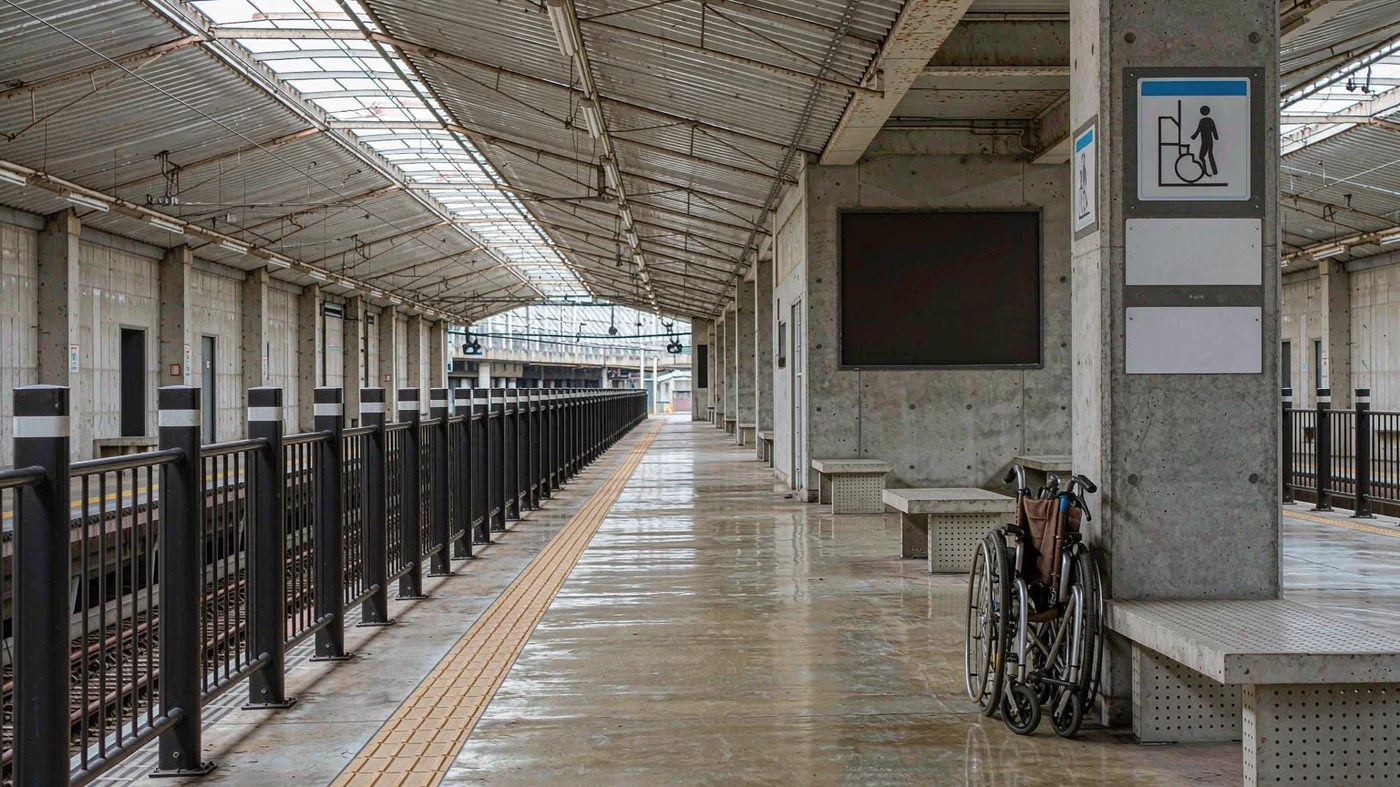
Start With Your Mobility Needs
Write down your wheelchair’s length, width, and height, whether it folds, and whether you can transfer to a vehicle seat. If you do not use a wheelchair, note how far you can comfortably walk or stand, whether you can manage stairs, and whether you need a seat while waiting. Share the relevant details with each operator rather than asking only whether a service is “accessible.”
JR East’s dimensions are an operator-specific starting point, not a size rule for every train or taxi in Tokyo. If your chair exceeds them or has an unusual design, consult JR East before booking; even a chair within the listed dimensions needs a suitable train and station combination [3].
JR East provides platform escorts and boarding assistance. It asks travelers who need help moving within stations or trains, including toilet assistance, to travel with a companion who can provide that help [3]. Confirm the assistance you need rather than assuming a boarding escort includes personal care.
Arrange the Airport-to-Hotel Journey
Confirm your arrival airport and terminal before choosing the onward ride. The airport services described here are at Haneda; do not assume the same arrangements apply at Narita. At Haneda, information counters and concierges provide assistance within a terminal designed around universal-design principles [5].
Ask your airline to confirm assistance from the aircraft through arrivals and where its staff will hand you over. Haneda offers rental wheelchairs for use within the airport, including chairs usable as far as the aircraft seat. Terminal information phones can be used to request delivery to a location such as the station or parking area [6]. Trained Care-Fitter staff also offer special assistance, with advance reservations available [7]. Confirm availability and the meeting point for your flight; an airport rental chair is not your mobility arrangement for the rest of Tokyo.
Compare the complete rail route to your hotel with a pre-arranged wheelchair-compatible vehicle. For rail, include station access, boarding help, transfers, and the final street route. For a vehicle, confirm that your chair fits, whether you must transfer, the pickup point, luggage space, and the full quoted price. Keep your hotel address in Japanese and English and save the contact details for each handover.
Check Every Station Entrance and Transfer
Check the departure station, every interchange, and the destination station separately. Tokyo Metro’s completed barrier-free routes can use elevators, slopes, stairlifts, or wheelchair-compatible escalators [2]. If you need an elevator-only route, check for that specifically. Use the English station facility search to locate elevators, stairlifts, and accessible toilets [8].
Tokyo Metro also lists tactile guide blocks and Braille information among its accessibility measures [9]. Choose facilities relevant to your needs; the presence of a tactile route or an escalator does not establish wheelchair access.
At JR East stations, approach staff for the platform escort and help getting on and off the train. Allow extra time, as JR East warns that the escort can take time [3]. Tell staff your destination and any transfers, and ask how assistance at the next station will be arranged.
Before You Leave the Hotel
- Save the exact accessible entrance and exit, not just the station name. Keep an offline screenshot of the route from the exit to your destination.
- Check elevator notices. Tokyo Metro publishes daily and monthly suspension information for inspections and renewal work [10]. A scheduled route can become unusable when its required elevator is unavailable.
- Allow time for the street approach, elevator waits, staff assistance, and transfers. Do not treat the app’s train time as the complete door-to-door journey.
- Save an alternative accessible station or a confirmed compatible vehicle option. If an elevator fails, ask staff for an accessible alternative before entering an unfamiliar route.
Reserve Long-Distance Wheelchair Spaces
You do not need a Shinkansen reservation for an ordinary city-only itinerary. If you are leaving Tokyo, arrange the wheelchair space before committing to tight onward connections. JR East accepts applications for wheelchair-accessible seats on relevant trains through station counters or by phone from one month before departure at 10:00 Japan time. Its FAQ also describes online applications for Shinkansen departures from JR East stations; popular services may fill [4].
Give the date, train, boarding and arrival stations, wheelchair dimensions, and whether you will remain in your chair. Ask where to meet staff, how assistance works at both ends, and what to do if your train or travel time changes.
Tokaido Shinkansen Departures
For the Tokaido Shinkansen from Tokyo toward Nagoya, Kyoto, or Shin-Osaka, check JR Central’s rules rather than assuming JR East’s booking arrangements apply. All Tokaido Shinkansen trains have wheelchair-compatible accommodation. Some N700S services have six wheelchair spaces: three window-side spaces without transfer seats and three aisle-side spaces with transfer seats [11].
JR Central’s website application form accepts requests up to two days before travel, but a submitted request is not a confirmed reservation. The same operator page lists separate online reservation services, so the form deadline should not be treated as a deadline for every online booking channel. Wheelchair-compatible seats generally go on sale one month before travel at 10:00 Japan time; for some six-space N700S services whose operation is decided during the preceding month, spaces without transfer seats go on sale once the service is determined. Confirm the channel, space type, and actual availability with JR Central. Equipment substitutions can change the accommodation, so recheck before boarding [11].
Choose a Bus or a Suitable Taxi
Tokyo’s official visitor guide describes non-step buses and universal-design taxis, including arranging suitable taxis through an English-language app or hotel staff [12]. Universal-design taxis are designed for a range of passengers, including wheelchair users, older people, people with strollers, and pregnant travelers [13]. The label alone does not confirm that a particular vehicle can carry your chair.
At the end of fiscal 2024, Tokyo reported that all 1,447 Toei buses were non-step vehicles, with the fleet conversion completed in fiscal 2012 [14]. That fleet statistic is not a boarding guarantee at a particular stop. Ask the operator about your intended stop, ramp boarding, and wheelchair accommodation before relying on the service for a timed appointment.
What to Confirm When Booking a Vehicle
If you can transfer and your chair folds, ask whether an ordinary taxi can accommodate both you and the folded chair. If you need to remain seated in your chair, request that explicitly and have the company confirm the exact vehicle’s suitability.
- Provide wheelchair dimensions and any weight information the operator requests.
- Confirm ramp or lift compatibility, wheelchair restraint arrangements, companion seats, and luggage space.
- Agree on a pickup position with room for safe boarding and the vehicle’s ramp or lift.
- Get the pickup time, total quoted price, additional charges, cancellation terms, and contact number in writing.
For a large powered chair or reclining chair, discuss the exact model directly with the operator. Ask whether a specialist wheelchair vehicle or lift-equipped van is needed rather than assuming a universal-design taxi will fit.
Build a Door-to-Door Route Card
Choose your hotel after checking its actual entrance and the route to the station entrance you can use. A nearby station name does not tell you whether the pavement, crossing, building entrance, or station exit suits your needs. Ask the hotel to confirm the approach and drop-off point.
Planning example, not a tested itinerary: for a hotel-to-clinic trip, write down the hotel pickup point or accessible station entrance, the train and any transfer, the destination’s accessible exit, and the clinic’s step-free door. Work backward from the appointment time to include boarding assistance and registration. If the required elevator is closed, use a staff-confirmed alternative or a compatible vehicle confirmed in advance. Do not substitute an unverified exit just because it is closer.
Keep this route card with your hotel address, mobility requirements, emergency contact, and operator confirmations. Check the return journey too, including the time you expect to travel. These are planning prompts, not a claim that a specific route has been personally tested.
Coordinate Clinic Appointment Rides
This guide covers transport logistics, not whether a treatment is appropriate, safe, or effective. If you are traveling for care, use the clinic’s access instructions alongside a medical travel guide for treatment in Japan. Before committing to travel, the checks in how to choose a stem cell hospital in Japan belong to a separate provider-selection decision, not proof of transport accessibility or treatment efficacy.
Confirm the building, floor, entrance, step-free drop-off, and registration time directly with the clinic. Ask which appointments require attendance and whether the return pickup time should remain flexible. When discussing the stem cell treatment process in Japan, establish the actual visit schedule before booking rides; do not assume every stage requires travel to the clinic.
For a clinic visit, share your proposed dates and access questions with the patient support team. Ask for the appointment location and arrival instructions, then confirm vehicle suitability and boarding assistance with the transport operator.
Contact the Patient Support TeamPlanning Checklist
The timing below is a suggested planning sequence, not a universal assistance-booking deadline. Contact your airline and transport operators as soon as your needs and dates are known.
| When | Action | Confirmation to Keep |
|---|---|---|
| Before choosing routes or booking opens | Record mobility needs and wheelchair details | Dimensions, transfer ability, walking tolerance, personal-care assistance |
| As soon as dates are known | Arrange airport assistance and confirm the hotel approach | Terminal, handover point, accessible entrance, onward vehicle or rail route |
| When the relevant rail booking window opens | Apply for the required long-distance wheelchair space | Train, space type, operator acceptance, staff meeting point |
| Before a timed outing or appointment | Confirm both the outward and return journeys | Station exits, transfers, vehicle fit, pickup terms, backup plan |
| Before leaving on the day | Check elevator and service notices | Usable route, assistance arrangements, saved contacts and offline map |
Keep the Plan Specific
Tokyo Metro’s 180-station barrier-free-route coverage and Toei’s non-step fleet are useful starting points, not promises about your individual journey. A workable plan names the entrance, boarding assistance, vehicle, destination door, and fallback for each trip. Recheck the relevant operator pages before travel, especially where access depends on an elevator or a reserved wheelchair space.




