
For an initial stem cell consultation in Japan, records that describe your current health are most useful when they cover roughly the last 1–3 months. That usually means your doctor’s summary, medication list, recent blood tests, current symptoms, and physical ability. This is a practical preparation range, not a nationwide Japanese rule. MRI, CT, and X-rays do not automatically expire after three months. Keep older pathology reports, surgery reports, and scans that may help the doctor compare changes over time. One Japanese national hospital asks international patients to submit updated records when an application has been inactive for more than 3 months, but that is the hospital’s own rule rather than a national standard.[1]
A practical first-review file usually includes a 1–2 page medical summary, a one-page timeline, your current medicines, recent laboratory reports, current imaging, and older records that still matter. When checking how old a test is, use the date the test was actually performed.

Use These Record Ages
| Record | What to Send | When to Update It |
|---|---|---|
| Medical summary | Latest doctor’s summary | Aim for the last 1–3 months if your condition is changing |
| Medication list | What you take now | Update on the day you submit your file |
| Blood tests | Latest relevant laboratory reports | Repeat only if the doctor needs newer results |
| MRI or CT | Latest study plus useful older comparisons | Update when symptoms, anatomy, injury, surgery, or treatment has changed |
| X-rays | Latest useful views | Update when the doctor needs newer or different views |
| Physical function | Current walking, movement, strength, or daily-activity information | Update if your ability has changed |
| Pathology | Original biopsy or tissue report | Do not replace it simply because it is old |
| Surgery report | Original operation report | Keep regardless of age |
| Older imaging | Scans that show change over time | Keep when comparison may help |
The 1–3 month range is a preparation guide, not a Japanese legal standard. Age alone does not decide whether a record is useful. A two-month-old report can become outdated after a major change in health, while a five-year-old surgery report may still contain information the doctor needs.
Prepare a 1–2 Page Medical Summary
The doctor should be able to understand the main facts of your case before opening every scan, blood result, and hospital note.
Include:
- exact diagnosis;
- when symptoms started;
- when the diagnosis was confirmed;
- main symptoms now;
- whether symptoms are stable, improving, or getting worse;
- important test or examination findings;
- treatments already tried;
- how well each treatment worked;
- previous operations or major procedures;
- current medicines;
- allergies;
- important other illnesses;
- what you can and cannot do now.
Instead of writing only:
Knee osteoarthritis.
give usable details:
Right knee osteoarthritis diagnosed in 2023. Pain is worse when using stairs and after about 20 minutes of walking. Physical therapy helped only slightly. Two injections gave temporary relief. Latest weight-bearing X-ray was performed in June 2026. No previous knee surgery.
The stem cell treatment process in Japan also looks at diagnosis, imaging, laboratory results, medicines, allergies, and previous treatment. A diagnosis name by itself is not enough for a meaningful review.

Use the Test Date
A single record can contain 4 different dates:
- January 8: MRI performed;
- January 10: radiology report written;
- March 2: report translated;
- April 15: report sent to Japan.
For deciding how old the MRI is, use January 8. A later translation or submission date does not make the scan newer.
The same applies to blood tests, biopsies, CT scans, X-rays, and other examinations. Use the date the examination or sample collection actually happened.

Send Complete Lab Reports
Copied numbers are not enough. The doctor needs the original context around the result.
A useful laboratory report should show at least these 5 items:
- test date;
- test name;
- result;
- unit;
- laboratory reference range.
Depending on your diagnosis, the doctor may need blood counts, kidney or liver function, blood sugar, inflammation markers, blood-clotting results, or tests related to your disease.
There is no reason for every patient to order the same panel. If your existing blood work is several months old, the better approach is to let the reviewing doctor tell you which results actually need updating.
This matters even more across borders because units differ between countries. “Glucose 110” or “creatinine 1.1” is incomplete without the unit.
Update Imaging Only When Needed
MRI, CT, and X-rays do not have one universal expiration date. What matters is whether the scan still matches your current condition.
Existing imaging is more likely to need updating after any of these changes:
- new or clearly worse symptoms;
- new weakness or numbness;
- major change in walking ability;
- a new injury;
- surgery after the scan;
- major treatment after the scan;
- a lesion or other finding that needs to be checked for change.
A two-month-old MRI taken before a new injury may no longer answer the doctor’s question. An eight-month-old MRI may still be useful if the condition has remained stable.
Older scans can also be valuable for comparison. Imaging from January 2025 and July 2026 gives the doctor about 18 months of change to review.
With X-rays, the view can matter more than the date. A knee specialist may need standing or weight-bearing images. A newer X-ray taken in the wrong position may be less useful than an older study taken correctly.
For knee cases, knee joint disorder records should be read together with pain, walking ability, previous treatment, and imaging rather than using imaging alone.

Send DICOM, Not Screenshots
If the doctor asks for the actual MRI or CT, a few phone photos or portal screenshots are not enough.
DICOM is the standard used to store and exchange medical imaging information.[2]
You may need 2 separate items:
- Radiology report: the written findings.
- DICOM files: the full digital scan that another doctor can review.
The Center Hospital’s international-patient instructions specifically request DICOM data when imaging is available.[3]
Ask the hospital or imaging center that performed the study for the complete DICOM examination plus the written report.
Keep Pathology and Surgery Reports
Old does not mean useless. Some records describe events that cannot be recreated later.
Keep:
- biopsy reports;
- pathology reports;
- important molecular or genetic test reports;
- operation reports;
- hospital discharge summaries;
- implant information;
- important post-operative imaging.
A pathology report from 5 or 10 years ago can still be the document that proves what was found in the original biopsy.
A surgery report from 2018 may still show which spinal level was treated, what hardware was inserted, and whether a fusion was performed.
Do not repeat a biopsy just to obtain a newer report. A new biopsy should be ordered because a doctor needs new tissue information, not because the old report has passed an arbitrary age.
Update Your Medication List on Submission Day
For each medicine, provide 4 details:
- name;
- dose;
- how often you take it;
- why you take it, if known.
Use the generic drug name when possible because brand names differ between countries.
If an important medicine was stopped recently, keep it in the record and add the stop date. For example:
Prednisone 10 mg daily — stopped May 2026.
Also include relevant supplements and herbal products.
Do not stop anticoagulants, steroids, immune-suppressing medicines, diabetes medicines, or other prescription drugs on your own because you are preparing for treatment.
Ask Before Repeating Infection Tests
Some cell-based procedures require infection screening. What you need depends on:
- whether your own cells or donor cells are used;
- how cells are collected;
- how they are processed;
- how the treatment is given;
- the medical institution’s protocol.
The distinction between your own cells and donor-derived cells can therefore affect preparation requirements.
Before ordering infection screening, ask:
- Which exact tests are required?
- How recent must each result be?
- Does the clinic require a particular test method?
Expect New Tests at 3 Stages
| Stage | What the Doctor Needs |
|---|---|
| Initial review | Diagnosis, current symptoms, treatment history, imaging, key laboratory results, medicines, and major medical risks |
| Treatment planning | Specific imaging, specialist examinations, laboratory tests, or physical-function measurements needed for the proposed plan |
| Pre-procedure check | Current safety information such as blood results, infection screening, or other tests required close to the procedure |
A laboratory result can be accepted for the first review and still need repeating later. The later test is being used for a different decision.
Match Records to Your Condition
| Condition | Records That May Matter Most |
|---|---|
| Knee or hip disorder | Orthopedic report, suitable X-rays, MRI when relevant, walking limits, previous injections, rehabilitation, and surgery history |
| Spinal disorder | Neurological examination, MRI or CT, surgery reports, hardware information, weakness, numbness, and rehabilitation records |
| Spinal cord injury | Injury date and level, surgery report, imaging, motor and sensory function, mobility, rehabilitation, and complications |
| Neurological disease | Neurologist’s report, current examination, medication response, walking or movement ability, and recent disease activity |
| Autoimmune disease | Specialist report, current disease activity, relevant laboratory results, organ involvement, medicines, and serious infection history |
| Previous cancer | Original diagnosis, pathology, stage, treatment received, latest oncology follow-up, and current disease status |
For spinal cord injury, the date of injury, neurological level, present motor and sensory function, rehabilitation history, and previous procedures are especially useful. The site’s spinal cord injury research page discusses why these details matter when reading the evidence.
Show What You Can Do Now
Words such as “better,” “worse,” and “severe” are too vague on their own. Numbers are more useful when you have them.
| Weak Description | More Useful Description |
|---|---|
| Walking is worse | I could walk 500 meters six months ago; now I need a cane after about 100 meters |
| Severe knee pain | Pain starts after about 10 minutes of walking and I cannot use stairs without holding a rail |
| Weak leg | I can stand without help but cannot climb one flight of stairs normally |
Useful records can include walking distance, use of a cane or wheelchair, stair ability, range of motion, ability to work, and ability to dress or bathe independently.
Translate Only the Records the Clinic Needs
The Center Hospital asks international patients to provide the original medical report with an English or Japanese translation, non-imaging test data with an English or Japanese translation, and DICOM imaging when available.[4]
Before paying to translate hundreds of pages, confirm what the receiving institution actually wants.
Start with these 7 items:
- current medical summary;
- main diagnosis;
- important imaging reports;
- relevant laboratory reports;
- pathology;
- surgery reports;
- current medication list.
Keep the original record with the translation. Do not change test values, units, drug doses, dates, or medical conclusions.
Write dates clearly. 03/04/2026 can mean March 4 or April 3. Write 4 March 2026 instead.
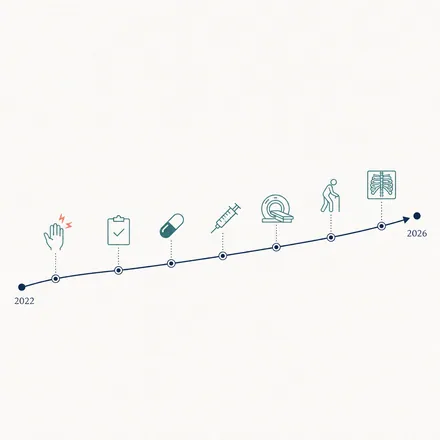
Build a One-Page Timeline
For many patients, 5–10 major events are enough to show the important history.
- March 2022: Right knee pain began.
- June 2022: Knee osteoarthritis diagnosed.
- August–December 2022: Physical therapy completed.
- February 2023: Hyaluronic acid injection.
- September 2023: Steroid injection; benefit lasted six weeks.
- May 2025: MRI performed.
- April 2026: Walking distance decreased.
- July 2026: New weight-bearing X-rays.
Include diagnosis, major imaging, surgery, major treatment, hospital admission, and clear improvement or worsening. Leave out routine appointments that did not change diagnosis or treatment.
Update Records After a Major Change
Send an update to the medical team if any of these happened after your records were prepared:
- new surgery;
- hospital admission;
- serious infection;
- new diagnosis;
- major medication change;
- new injury;
- rapid worsening;
- new weakness or numbness;
- major loss of mobility;
- new cancer diagnosis.
A medical summary written 2 weeks ago can already be incomplete if you were hospitalized yesterday.
Sudden severe weakness, stroke symptoms, serious infection, severe chest symptoms, major bleeding, or another medical emergency requires local medical care rather than waiting for an overseas consultation.
Do Not Repeat Tests Just to Make Them Newer
Do not automatically repeat MRI, CT, X-rays, broad blood panels, genetic testing, or biopsy before a doctor has reviewed what you already have.
If a new MRI is needed, the doctor can specify:
- which body area;
- which type of scan;
- which sequence;
- whether contrast is needed;
- when the scan should be performed.
This can save you from paying for a test that does not provide the information the doctor needs.
Get Physician Review Before Booking Travel
Before paying for non-refundable flights or accommodation, confirm that a licensed physician has reviewed your case, not just a coordinator who received the documents.
A physician may first request:
- missing imaging;
- new laboratory tests;
- confirmation of the diagnosis;
- another specialist’s opinion;
- treatment of another medical problem first.
The medical travel guide for stem cell treatment in Japan covers appointment timing, testing, interpretation, follow-up, and travel planning.
Confirm how your medical records will be transferred and who can access them. The site’s health data and medical records policy and third-party disclosure policy explain how patient information and outside parties are handled.
Verify the Exact Treatment and Legal Route
Being accepted for medical-record review does not mean a stem cell procedure has been shown to work for your condition.
Before treatment planning, get clear answers to these questions:
- What exact cells or product will be used?
- Are they your own cells or donor cells?
- How are the cells processed?
- How are they given?
- What evidence applies to your diagnosis?
- What risks and unknowns remain?
- What follow-up is required?
The International Society for Stem Cell Research provides patient information intended to help people assess stem cell treatments and clinical trials before making treatment decisions.[5]
The site’s stem cell safety guide for Japan covers treatment risks and questions to check before proceeding.
Japan also uses more than one legal route for regenerative medicine. The Act on the Safety of Regenerative Medicine covers regulated regenerative medicine provided in medical practice and research, while regenerative medical products are separately regulated under the pharmaceutical system.[6]
Amendments to Japan’s regenerative medicine law took effect on May 31, 2025.[7]
PMDA separately publishes information on approved regenerative medical products and their review reports.[8] Some products have conditional and time-limited approval, so “available in Japan,” “registered,” and “PMDA-approved for my condition” should not be treated as the same statement.[9]
The site’s Japan regenerative medicine registration and compliance page explains these routes in more detail.
If cells are collected and processed for an individual procedure, the cell processing center page explains what happens during cell processing and quality control.
Ask These 10 Questions Before Ordering Tests
- How recent must my medical summary be?
- Are my current blood tests recent enough for the first review?
- Is my existing MRI or CT sufficient?
- Do you need the original DICOM files?
- Should I send older scans for comparison?
- Do you need a specific X-ray view or MRI sequence?
- Which infection tests are required, if any?
- Which records need English or Japanese translation?
- Which tests should be done now, and which should wait until treatment planning?
- Has a licensed physician reviewed my records?
If the clinic has not given you a clear answer, send exact dates:
My medical summary was updated on 15 July 2026.
My latest blood tests were performed on 20 July 2026.
My MRI was performed on 10 January 2026.
My symptoms have remained stable since the MRI.
Please tell me which records need to be updated before physician review.

Organize the File Into 9 Sections
- Medical summary: 1–2 pages covering diagnosis, current condition, treatment history, and recent changes.
- Timeline: one page with about 5–10 major events.
- Medication list: current drugs, doses, allergies, and important recently stopped drugs.
- Imaging: latest relevant scans and older comparison studies.
- Laboratory reports: relevant results with dates, units, and reference ranges.
- Surgery and procedures: operation reports and important discharge summaries.
- Pathology: biopsy and tissue reports when relevant.
- Current function: walking, movement, neurological function, rehabilitation, and daily activities.
- Treatment history: what was tried and whether the result was none, partial, temporary, stopped because of side effects, or still effective.
Remove duplicate copies, billing-only pages, repeated appointment notes, and documents unrelated to the condition being reviewed. Keep the records that show diagnosis, current health, treatment response, major procedures, and change over time.
Finally
For most international patients, use roughly 1–3 months as a practical target for records that describe your current health. Update the medication list on submission day and organize the file into about 9 sections. A 1–2 page doctor summary and a one-page timeline of 5–10 major events give the reviewing physician the key facts quickly. Keep older pathology, surgery reports, and comparison scans. Before paying for new MRI, CT, blood panels, or biopsy, send the records you already have and ask the physician exactly what needs updating.
This article provides general medical information and does not replace individual assessment by a licensed physician. The records and repeat tests needed for your case depend on your diagnosis, current health, medical institution, and proposed procedure.
Where treatment is provided
GINZA NOA CLINIC, Ginza, Tokyo
This article was written and medically reviewed at GINZA NOA CLINIC. The photographs below were taken inside the clinic in Chuo-ku, Tokyo.



Royal Crystal Ginza 3F, 5-4-6 Ginza, Chuo-ku, Tokyo 104-0061
3 min from Tokyo Metro Ginza Station (Exit B6); 5 min from JR Yurakucho Station
In-house CPC, facility number FC3250034
WhatsApp +81-8070161366 · LINE +81-8075357788
Medically reviewed by Ryosuke Tanabe, MD (Director, GINZA NOA CLINIC) with Kotaro Yoshimura, MD, PhD (Professor of Plastic Surgery, Jichi Medical University) as technical advisor. Last reviewed 30 September 2026. Every treatment carries risks — ask what they mean for your case at the consultation. Registration and credentials · How we review content