
Short answer: Clinics reduce cell mix-ups by checking two patient identifiers, labeling samples at collection, keeping batches separate, and recording every transfer. Before treatment, staff match the intended recipient, product identifiers, and treatment order. A mismatch means stopping and investigating—not guessing. Laboratory tests can support identity checks, but they do not replace this tracking system.
What Needs to Stay Matched
A mix-up can mean giving a product to the wrong patient, selecting the wrong donor product, or mixing material during processing. Prevention depends on a chain of identity: the records linking the source material, every resulting container, and the intended recipient. The chain of custody records who handled the material and when.
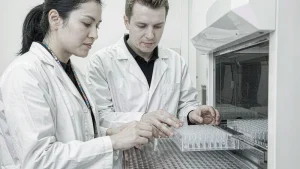
Both autologous and allogeneic cell preparations need traceability. Autologous cells come from the patient; allogeneic cells come from a donor. For autologous treatment, the source and recipient must be the same person. For donor-derived treatment, staff must match the selected donor product to the intended recipient and order—not expect the donor’s name to match the patient’s.
Not every preparation is cultured, frozen, or supplied in a syringe. The checkpoints below apply to the steps a particular product actually undergoes; they are questions to ask, not proof that every clinic follows the same procedure.
Labeling at Collection
Staff should ask you to state at least two person-specific identifiers, such as your full name and date of birth, and compare them with the collection order. A room or bed number does not count as an identifier. WHO recommends at least two identifiers before care and specimen collection Ps solution2 patient identification.pdf?sfvrsn=ff81d7f9_6.
Ask for the collected container to be labeled and checked before it leaves the collection area. The label and collection record should link the material to its source and record relevant collection details. A tracking code may carry that link through the laboratory; labels do not all need to display personal details in the same format. An unlabeled filled container, or a label that cannot be reconciled with the order, needs immediate clarification.
Keeping Laboratory Batches Separate
Inside a cell processing center, ask how staff separate open work on different batches, identify newly split containers, and check labels during freezing, storage, thawing, and preparation. Handling one batch at a workstation at a time is one separation approach; the relevant question is how the facility’s actual workflow prevents unintended mixing.
At facilities using ISBT 128, standardized labels include a Donation Identification Number and product coding. These identify the donation and describe the product; the donation number alone is not a substitute for checking the particular product and its intended recipient IN 005 ISBT 128 for Cellular Therapy An Introduction v13.pdf.
Label checks need a defined procedure, whether supported by a second trained person, an electronic system, or both. As one regulatory example, US rules for covered human cells, tissues, and cellular and tissue-based products require labeling procedures that prevent mix-ups and verify label accuracy, legibility, and integrity. This is a US requirement, not a universal rule for every clinic worldwide CFR 2025 title21 vol8 sec1271 250.xml.
The handoff record should connect dispatch with receipt: which product left, who transferred it, when it arrived, and whether the seal and required transport conditions were acceptable. Assigned storage locations and inventory records help staff retrieve the intended container rather than a similar-looking one.
| Checkpoint | What to ask the clinic to explain |
|---|---|
| Collection | Which two identifiers are checked, and when is the filled container labeled? |
| Transport | How are dispatch, receipt, container identity, and required transport conditions recorded? |
| Processing | How are batches separated, and how are labels checked when material is transferred or split? |
| Storage | How does the inventory identify the exact container and its location? |
| Preparation | How is the selected product matched to the treatment order? |
| Administration | Who verifies the recipient and product, and what happens if anything disagrees? |
What Testing Can and Cannot Prove
Cell type and donor identity are different questions. Two patients’ cells can share the same appearance and surface markers. Those features cannot, by themselves, establish whose cells are in a container. A sterility result checks for microbial contamination; viability measures living cells. Neither proves donor identity.
For example, the 2006 ISCT criteria characterize culture-expanded human mesenchymal stromal cells using plastic adherence, at least 95% expression of CD105, CD73, and CD90, no more than 2% expression of specified exclusion markers, and the ability to form bone, fat, and cartilage cell types in vitro. The exclusion panel includes CD45, CD34, CD14 or CD11b, CD79a or CD19, and HLA-DR. These are cell-characterization criteria—not proof of the patient’s identity, a universal batch-release specification, or evidence that an injection treats an illness 16923606.
DNA-based authentication can compare a human cell culture with a reference profile. In the human cell-line context, the ICLAC guide discusses short tandem repeat (STR) profiling under the 2022 ANSI/ATCC standard, including at least 13 core loci and an 80% match threshold for interpreting related profiles. This does not mean that an 80% result alone proves a clinical dose belongs to a patient, or that every clinic must run STR testing on every dose. The test, reference sample, and interpretation must suit the material and purpose ICLAC_Guide to Human Cell Line Authentication_02 Mar 2023.pdf.
Ask which identity tests apply to your preparation, what they establish, and how results link to its batch record. An unexplained label mismatch is not permission to administer a product merely because another laboratory test passed.
The Check Before Administration
Immediately before administration, staff should match your identifiers with the treatment order and match the product’s identifiers with the product intended for you. They should also verify the planned route and dose. In the treatment process in Japan, as elsewhere, this identity check is separate from the earlier decision about whether the treatment is appropriate.
Where a wristband is used, it forms part of that comparison. You should be asked to state your identifiers rather than simply agree with a name someone reads out. WHO’s guidance supports active patient involvement; scanning and spoken checks should follow the facility’s procedure rather than be treated as alternatives with one automatically superior to the other Ps solution2 patient identification.pdf?sfvrsn=ff81d7f9_6.
A Practical Mismatch Scenario
Suppose the batch identifier on the product does not agree with the preparation record. This is an illustrative situation, not a reported patient case. Ask staff to pause before administration and explain how the discrepancy will be resolved. Being told that the cells passed a sterility test does not answer the identity question.
You can observe the final identity check and ask how the batch record connects to your order. You cannot verify the entire laboratory chain just by watching a bedside check. A useful response identifies the records and responsible team; reassurance based only on staff recognizing your face does not establish the product’s identity.
When Details Do Not Match
Do not proceed with an unresolved identity mismatch. Keep the product out of use while the responsible team investigates and documents the resolution.
The investigation may involve checking collection records, transfer logs, storage selection, and the treatment order. Ask what was inconsistent, who is reviewing it, and what documented decision is required before treatment can proceed. A corrected record must reflect a verified explanation—not a guess made to keep an appointment on schedule.
Questions Before You Agree
When choosing a stem cell hospital in Japan, ask for explanations tied to the actual preparation rather than a general assurance that the facility is safe:
- Which identifiers link the collection, laboratory records, final product, and treatment order?
- Is this my own material or a donor-derived product, and how is the intended recipient recorded?
- Which processing facility handles it, and how are transfers and storage locations recorded?
- Which identity and release checks apply, and who authorizes use?
- Can staff show or explain the relevant product identifier before administration without disclosing another person’s private information?
- What is the stop-and-investigate procedure for a mismatch?
- Is the treatment an approved product used for its approved indication, an experimental intervention in a clinical trial, or clinic-provided care under a filed plan?
Identity Checks Do Not Prove Safety or Benefit
Correct identity does not rule out contamination, bleeding, infection, or lack of benefit. The FDA has warned about serious harms associated with unapproved regenerative medicine products in the United States Important patient and consumer information about regenerative medicine therapies.
A separate US contamination investigation reported 12 patients with infections after receiving unapproved cord blood-derived products in 2018. All were hospitalized, with initial stays of 4–58 days; bacteria were also found in unopened vials. This was one outbreak, not a general error rate, and it was not evidence of a patient-identity mix-up Mm6750a5.htm.
In Japan, treatment-plan filing under the Act on the Safety of Regenerative Medicine is distinct from product approval. A filed plan or facility number does not establish efficacy for your condition 4980. When checking Japan’s regenerative medicine registration and compliance framework, distinguish regulatory status from the batch-level records that connect the product to you.
Need help asking about the identity and batch records for a proposed treatment?
Bottom line: Look for a documented connection from source material to final product and intended recipient, with checks at each handoff and a clear stop rule for discrepancies. These safeguards reduce mix-up risk; they do not guarantee an error-free process or an effective treatment.
General information only, not personal medical advice. Discuss the specific preparation, procedure, risks, and alternatives with a qualified clinician.




