
There is no established clinical treatment that regrows a complete missing adult tooth. Human cell-therapy evidence cited here concerns pulp or periodontal tissues; anti-USAG-1 whole-tooth drug development is a separate experimental approach. Regenerative dentistry review
A drug leads the field, with the anti-USAG-1 antibody entering Phase I in October 2024 with 30 participants spread over 5 dose steps, 6 per step, and the top step at 60 times the lowest.[2]
TRG035’s early human program is primarily a safety and pharmacokinetic investigation, not proof that a missing adult tooth regrows. The sponsor announced completion of PMDA’s Phase IIa clinical-trial-notification investigation on August 17, 2026; that is a development milestone, not a positive efficacy result or marketing approval. Dated sponsor announcement
The developer’s target is severe congenital tooth agenesis, often termed oligodontia when at least six permanent teeth are absent, excluding third molars. Trial age ranges and entry requirements must be checked in each protocol; this target does not establish applicability to adults who lost teeth later.
Periodontal studies measure support around existing teeth, not replacement of a missing tooth. A 2026 meta-analysis reported different endpoint effects of about 0.51–1.09 mm; this is a range across outcomes, not an attachment-gain confidence interval.
Where the human trials stand
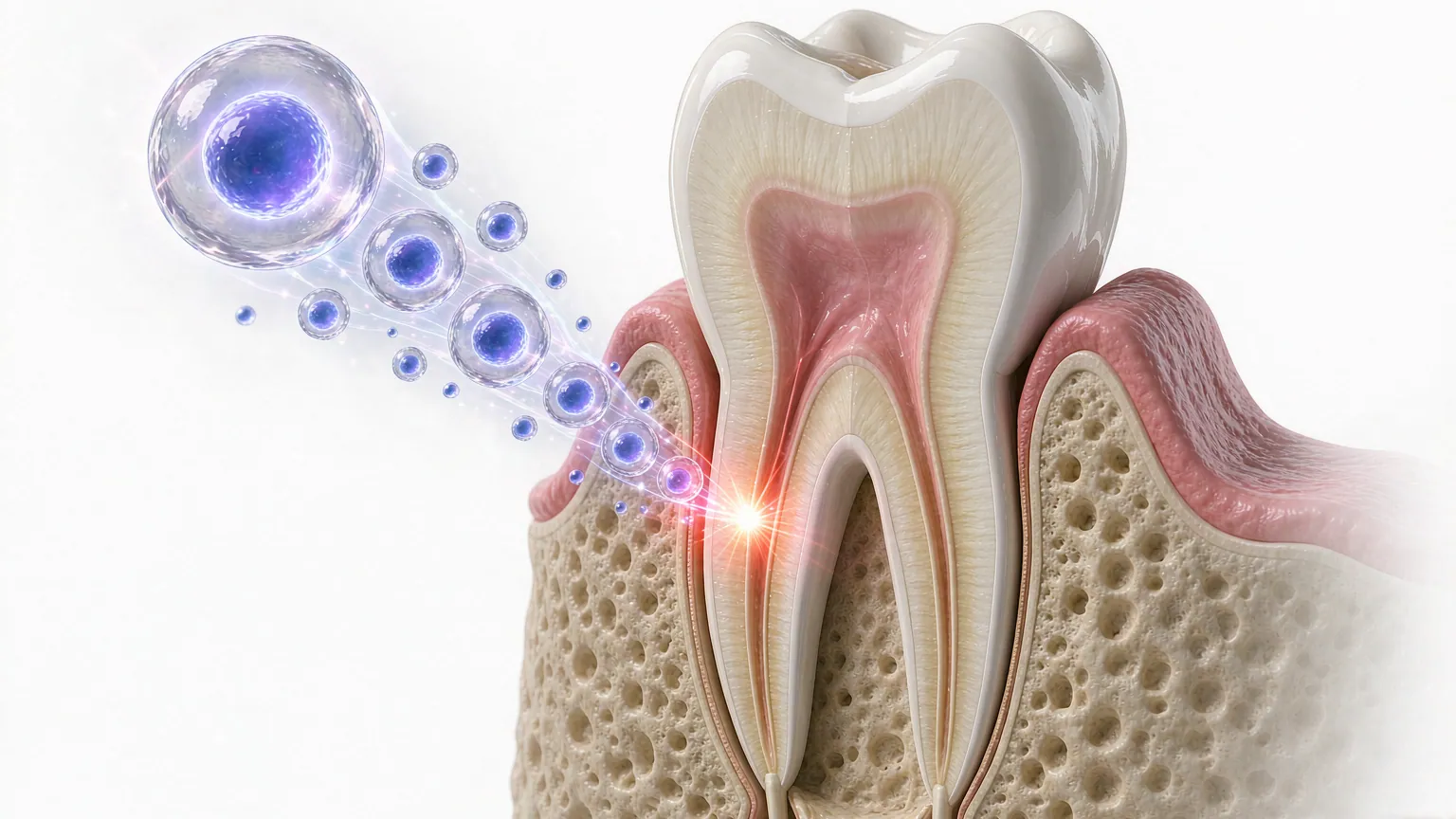
Drug development leads cell therapy on this problem. TRG-035 is a monoclonal antibody that blocks USAG-1, a protein suppressing tooth development, and removing that block lets a dormant tooth germ keep growing.[4]
The 2021 anti-USAG-1 experiments reported tooth development in animals without a transplanted cell component. Animal dental similarities provide a rationale for research, not evidence that adult human tooth loss can be reversed. Original animal study
Funding has followed. Toregem BioPharma closed a pre-Series C round in May 2026 worth JPY 850 million, about USD 5.3 million, and total funding with subsidies passed JPY 4.6 billion.[3]
Dose steps span 60 fold. At a 60 kg adult weight the 0.40 mg/kg step equals 24 mg and the 24.0 mg/kg step equals 1,440 mg. Registry entry criteria also required a BMI of 18.5 to 25.0 and a weight of 40 to 80 kg.[2]
Twenty-two months separate first enrolment from the completed Phase IIa filing review, roughly 678 days.[2][3]
Japan designated TRG035 an orphan drug for severe congenital oligodontia on September 29, 2025, according to the sponsor. Orphan designation provides development and review incentives and may support an extended post-approval re-examination period; it is not proof of efficacy or a guaranteed approval date. Sponsor designation announcement
| Route | Target tissue | Human sample | Status |
|---|---|---|---|
| Pulp regeneration | Pulp and dentine inside the canal | 5-patient pilot, 36-patient trial | Short-term data only |
| Periodontal regeneration | Ligament, alveolar bone, cementum | 10 pooled trials, 132-patient trial | Small but measurable |
| Whole-tooth regeneration | Complete tooth and root | Animal models only | Phase I tested safety |
Missing teeth and missing tooth germs are different problems
Acquired tooth loss comes from periodontitis, caries or trauma. The World Health Organization estimates oral disease affects nearly 3.7 billion people, and severe periodontal disease accounts for more than 1 billion cases, 27% of that total.[9]
Complete tooth loss climbs steeply with age, reaching about 7% at 20 and over and about 23% at 60 and over, a 3.3 fold gap. A healthy periodontal pocket measures 1 to 3 mm, so a 6 mm reading is twice the healthy ceiling.[9][10]
Congenital tooth agenesis and tooth loss after decay, periodontitis or trauma are different conditions. Not every congenital case retains a drug-responsive tooth germ. The Japanese population estimates quoted by the developer are not eligibility estimates. Developer’s proposed mechanism
The 600,000 figure equals about 0.5% of Japan’s 120 million people. Severe congenital hypodontia means six or more permanent teeth missing from birth, and that group carries the orphan drug designation.[4]
Adults who lost teeth to disease depend on a hypothetical third dentition, a pathway that remains a hypothesis in 2026.[4]
What regeneration inside a tooth already achieves
A 2017 pilot transplanted autologous dental pulp stem cells with G-CSF into emptied root canals in 5 patients. Electric pulp testing turned positive in 4 of the 5 at 4 weeks, which is 80%.[11]
At 24 weeks MRI signal approached that of normal pulp. Cone beam CT showed functional dentine formation in 3 of the 5, and no adverse events or toxicity appeared in the group.[11]
A randomised controlled trial enrolled 36 children aged 7 to 12. Twenty-six received aggregates of autologous stem cells from exfoliated deciduous teeth, 10 served as controls, and follow-up ran 12 months.[12]
Regenerated pulp carried blood vessels and nerves. Roots of immature permanent teeth kept elongating over 12 months and the apical foramen narrowed. Case counts stayed between 5 and 36 with the longest follow-up at 12 months, so pulp vitality at 5 years remains unmeasured.[12]
The 26 treated and 10 control children describe allocation and analyzed sample sizes, not a 72% success rate. The five-person pulp pilot’s 4/5 vitality response and 3/5 dentine observations are separate small-sample outcomes.
The specific periodontal injection study highlighted here assessed six-month outcomes. Other dental studies have different follow-up durations; this should not be generalized to the entire periodontal-regeneration field.
The measured size of periodontal regeneration
A 2026 meta-analysis pooled 10 clinical trials of mesenchymal stem cells for periodontal regeneration. Probing depth fell 0.51 mm more than control and clinical attachment improved 0.75 mm more, with both confidence intervals excluding zero.[5]
Bone measures moved too. The cementoenamel junction to defect base fell 0.49 mm and intrabony defect depth fell 1.09 mm. Gingival recession did not follow, at 0.18 mm with a p value of 0.07, which falls outside significance.[5]
The 2025 publication pooled two randomized studies: 96 participants in an investigator-initiated trial and 36 in a phase I trial, totaling 132 participants and 158 teeth. That is separate from the 10-trial meta-analysis; 132 cannot be used as the meta-analysis denominator. Full original report
In a post hoc stage III subgroup, attachment loss improved by 1.67 mm with cells versus 1.03 mm with saline at six months: an additional 0.64 mm (95% CI for the added improvement, approximately 0.05–1.23 mm). The main trial did not demonstrate a statistically significant overall attachment-loss advantage. The favorable subgroup result is exploratory. Trial results and Table 3
The stage III post hoc comparison included 54 cell-treated and 40 saline-treated participants: 94 people, or 71.2% of the overall 132-person cohort. It should not be presented as a prespecified positive result for everyone enrolled.
No serious adverse events were reported across the full group, at a dose of 10,000,000 cells per tooth. A 6 month window cannot speak to events one or two years later.[6]
Taken against baseline, 0.51 mm equals 8.5% of a 6 mm probing depth, 0.49 mm equals 8.2%, and 1.09 mm equals 18.2%.[5][6]
The periodontal endpoints measure different anatomical features. Their millimetre changes should not be divided by one another or translated into a single percentage of tooth regeneration.
Gingival recession did not show a statistically significant between-group change in the cited meta-analysis (0.18 mm, p=0.07). Statistical heterogeneity describes variation between study results, not the relative clinical effectiveness of different endpoints.
| Study | Sample | Main result | Strength |
|---|---|---|---|
| 2026 meta-analysis | 10 clinical trials | Probing depth 0.51 mm lower, attachment 0.75 mm better | I² 62% and 40%, certainty high to moderate |
| 2025 multicentre trial | 132 patients, 158 teeth | Attachment 1.67 mm against 1.03 mm | Stage III subgroup, post hoc, 6 months |
Four gates whole-tooth regeneration has not cleared
The company’s stated target year is 2030, four years from 2026, and the Phase IIa filing review only completed in August 2026.[3]
- Placement has to be exact. A tooth germ must start in the empty socket, and unwanted supernumerary or ectopic tooth development is a risk requiring investigation, while human placement data stand at 0.
- Eruption and occlusion must follow. Ferrets grow a new tooth that erupts and meets its neighbour, and the comparable human case count is 0.
- Durability of a newly regenerated whole human tooth remains unestablished. Six-month periodontal injection results cannot answer how long a whole tooth would last.
- Reproducibility stays unknown. Three stages separate safety data in 30 people from a repeatable effect.
Across 10 trials, mesenchymal stem cells produced statistically significant changes in probing depth, attachment level, cementoenamel junction to defect base and intrabony defect depth. Trial numbers stayed limited, heterogeneity reached 62% for probing depth, and certainty of evidence ran from high to moderate. Interpretation should stay cautious.[5]
Statistical significance describes the compatibility of the data with a specified null model, not the probability that a treatment works. One patient will not necessarily see the same 0.75 mm.
What an adult with a missing tooth can choose today
Adult tooth replacement still comes down to three options and one special case. The special case requires necrotic pulp and an open apex together, so a missing adult tooth falls outside it.[14]
- Implant. A titanium screw integrates with alveolar bone and has no periodontal ligament, so load transfer differs from a natural tooth, and the trade is one operation plus a 3 to 6 month healing wait.
- Fixed bridge. A conventional bridge usually requires preparation of adjacent abutment teeth; resin-bonded and other designs may need less preparation.
- Removable denture. No tooth reduction is needed, chewing efficiency runs below natural teeth, and fit and wear require periodic assessment; there is no fixed five-year replacement rule for every patient.
- Regenerative endodontic treatment. An established option in selected immature permanent teeth with necrotic pulp. Periodontal regenerative surgery also exists; neither procedure regrows a missing whole tooth.
- Orthodontic space closure. One gap in the arch closes by moving neighbouring teeth, and the overall occlusion changes with it.
Regenerative endodontic treatment runs over two visits. The canal is disinfected, bleeding is induced to form a clot as a scaffold, and a bioceramic material seals the coronal access.
Treatment process in Japan sets out the record review, collection, processing and follow-up sequence. Dental follow-up points fall at 6, 12 and 24 months before switching to annual checks.[14]
| Option | Condition | What happens | Main gap |
|---|---|---|---|
| Implant | Bone and general health allow | Titanium fixture, then osseointegration | No ligament, still surgery |
| Fixed bridge | Healthy teeth on both sides | Neighbours reduced as abutments | Abutment preparation depends on bridge design |
| Removable denture | Multiple teeth missing | Impression, fitting, periodic adjustment | Lower chewing efficiency, faster bone loss |
| Orthodontic closure | Arch allows tooth movement | Teeth moved under continuous force | Overall occlusion changes |
| Regenerative endodontics | Young tooth, open apex | Disinfection, then induced blood clot | Saves the tooth, grows no new one |
How to tell a credible regeneration offer
Anyone offered a regeneration service should treat these phrases as triggers for verification. Breakthrough, clinically proven, guaranteed new teeth, completely safe, risk free, rebuild bone, cure periodontitis, world class, government approved treatment.
A verifiable version names the numbers. Pooled results from 10 trials showed statistically significant changes in several periodontal measures, with limited trial numbers and heterogeneity of 62% for probing depth.[5]
Japan separates plan filing from product approval, and a filed plan does not establish efficacy. Three items deserve a direct answer, covering cell source and dose, comparator and follow-up points, and regulatory status.[15]
How to read Japan’s regulatory position
Japan regulates regenerative service provision under the Act on the Safety of Regenerative Medicine. Providers classify risk, pass review by a certified committee, then submit the plan to the authority. Registration and compliance in Japan details how far that sits from product approval.[15]
Product authorisation travels a separate route, with review reports and approved product lists published by the PMDA. Regenerative medicine overview and safety in Japan cover the surrounding evidence.[16]
Japan’s provision-plan database identifies the provider, treatment and committee. A developer’s 22-month interval between trial milestones cannot predict how long another therapy will take to develop or when it will become available. Official provision-plan database
Financing can be checked against the same disclosures. The JPY 850 million round equals about USD 5.3 million, an implied rate near 160 yen to the dollar, and cumulative funding of JPY 4.6 billion converts to roughly USD 29 million.[3]
Cell origin needs separate scrutiny. Autologous against allogeneic cells turns on collection and immune questions, where autologous cells need harvesting and culture while allogeneic cells skip harvesting and shift the regulatory burden. A cell processing centre handles the culture and release steps. The 2025 trial used allogeneic dental pulp cells.[6]
What to prepare before deciding
A plan or quote becomes comparable once its items are separated against the cost breakdown and the medical records templates.
- Periodontal diagnosis and chart, covering probing depth, bleeding, recession, mobility and attachment across 5 readings.
- Recent imaging, periapical or panoramic, plus the CBCT report where one exists; records from the last 1 to 3 months are the most useful.
- Previous periodontal care, with one line of outcome each for deep cleaning, surgery, grafting and regeneration.
- Medication and major conditions, including the most recent HbA1c where diabetes forms part of the history.
- Smoking status, since the 2025 trial excluded anyone above 10 cigarettes a day.[6]
- All 8 fields of the proposal, covering cell source, dose, route, number of administrations, materials, price, follow-up and regulatory wording.[6]
- Dose unit, recording whether each tooth receives 1×10⁶ or 1×10⁷ cells, a 10 fold difference.
- Comparator and endpoint, covering whether a control arm exists, whether follow-up runs to 6 months or 24 months, and which endpoint counts.
Placing the 132-patient trial beside the 30-person Phase I shows which piece of evidence an offer quotes, and whether child data has been moved onto adults. Indications and contraindications uses the same comparison.[6]
Send the plan or quote you have been given, even if it is incomplete. We compare it line by line against the published evidence, including 10 pooled trials, 132 patients in the injection trial and the 30-person Phase I.
You get a comparison across 4 fields, covering cell source, dose, follow-up points and regulatory wording, plus a question list for your own dentist. We do not diagnose, treat or recommend providers.
Send your plan and quote, and we will return the evidence comparison
Sources
Official data and peer-reviewed figures carry a citation at the end of the sentence. Figures described as typical industry ranges, such as implant healing waits and denture relining cycles, are marked with “typically” and carry no separate citation. The following values are calculated inside the article from the figures already cited. Dose and weight conversion uses 24 divided by 0.40 equalling 60, and 24 mg/kg multiplied by 60 kg equalling 1,440 mg. Percentage and multiple calculations use 1.67 minus 1.03 equalling 0.64, 26.81 divided by 17.43 equalling 1.54, and 0.51 divided by 6 equalling 8.5%. Sample size multiples use 132 divided by 30 equalling 4.4 and 36 divided by 5 equalling 7.2. Currency conversion assumes roughly 160 yen to the dollar. The Japanese population share uses 600,000 divided by 120 million equalling 0.5%. The month to day conversion uses 22 months equalling 678 days.
- The next generation of regenerative dentistry: from tooth development biology to periodontal tissue, dental pulp, and whole tooth reconstruction in the clinical setting. Regenerative Therapy, 2025. pmc.ncbi.nlm.nih.gov
- Ministry of Health, Labour and Welfare of Japan, Clinical Trial Portal. Phase I single-administration study of TRG035 in healthy adults (jRCT2051240154), registered October 8, 2024. jrct.mhlw.go.jp
- Toregem BioPharma Co., Ltd. News: completion of the PMDA investigation of the clinical trial notification for the TRG035 Phase IIa trial (August 17, 2026); pre-Series C financing of JPY 850 million (May 19, 2026). toregem.co.jp
- Toregem BioPharma Co., Ltd. Our technology: anti-USAG-1 antibody, congenital and acquired tooth loss, and the third dental crest. toregem.co.jp
- Ridho FM, Irmawati A, Labib R, et al. Therapeutic efficacy of mesenchymal stem cells in periodontal regeneration: a systematic review and meta-analysis of clinical trials. Journal of Yeungnam Medical Science, 2026, 43: 42. e-jyms.org
- Liu Y, Liu Y, Hu J, et al. Impact of allogeneic dental pulp stem cell injection on tissue regeneration in periodontitis: a multicenter randomized clinical trial. Signal Transduction and Targeted Therapy, 2025, 10(1): 239. pmc.ncbi.nlm.nih.gov
- Murashima-Suginami A, Kiso H, Tokita Y, et al. Anti-USAG-1 therapy for tooth regeneration through enhanced BMP signaling. Science Advances, 2021, 7(7): eabf1798. pubmed.ncbi.nlm.nih.gov
- Toregem BioPharma Co., Ltd. TRG035 designated as an orphan drug by Japan’s Ministry of Health, Labour and Welfare for severe congenital oligodontia, September 29, 2025. toregem.co.jp
- World Health Organization. Oral health (fact sheet). www.who.int
- National Institute of Dental and Craniofacial Research. Periodontal (Gum) Disease. www.nidcr.nih.gov
- Nakashima M, Iohara K, Murakami M, et al. Pulp regeneration by transplantation of dental pulp stem cells in pulpitis: a pilot clinical study. Stem Cell Research & Therapy, 2017, 8: 61. pmc.ncbi.nlm.nih.gov
- Functional dental pulp regeneration: basic research and clinical translation. International Journal of Molecular Sciences, 2021, 22(16): 8991. pmc.ncbi.nlm.nih.gov
- ClinicalTrials.gov. A phase 2, randomized, double-blind, parallel, placebo-controlled study to evaluate efficacy and safety of local injection of human dental pulp mesenchymal stem cells for the treatment of chronic periodontitis patients (NCT05924373). clinicaltrials.gov
- Regenerative endodontic treatment in an immature permanent tooth with necrotic pulp and periradicular lesion: a case report with 24-month follow-up. pmc.ncbi.nlm.nih.gov
- Ministry of Health, Labour and Welfare of Japan. Regenerative medicine, cell therapy and gene therapy [in Japanese]. www.mhlw.go.jp
- Pharmaceuticals and Medical Devices Agency (Japan). Review information and approved products. www.pmda.go.jp
Where treatment is provided
GINZA NOA CLINIC, Ginza, Tokyo
Clinic information supplied by this website. Facility photographs and contact details do not establish the effectiveness of a treatment described in this article.

Royal Crystal Ginza 3F, 5-4-6 Ginza, Chuo-ku, Tokyo 104-0061
3 min from Tokyo Metro Ginza Station (Exit B6); 5 min from JR Yurakucho Station
In-house CPC, facility number FC3250034
WhatsApp +81-8070161366 · LINE +81-8075357788
The previous page version named clinical reviewers and a review date of 30 September 2026. Their approval of this revised text has not been verified; a new specialist review is pending. Every treatment carries risks — ask what they mean for your case at the consultation. Registration and credentials · How we review content