
To bring prescription medicines to Japan, check each active ingredient against Japanese rules, count the supply you will carry, and obtain any required documents before departure. For an ordinary, permitted prescription medicine, up to a one-month supply does not require an Import Confirmation (Yunyu Kakunin-sho); a larger supply does. Controlled medicines have separate rules: narcotics and stimulants’ raw materials such as lisdexamfetamine need advance permission, while Adderall cannot be imported even with a prescription [1] [2].
How much you can bring
The Ministry of Health, Labour and Welfare (MHLW) lists these personal-use allowances without Import Confirmation, formerly called Yakkan Shoumei. They do not override ingredient bans or the separate controlled-medicine requirements below [1].
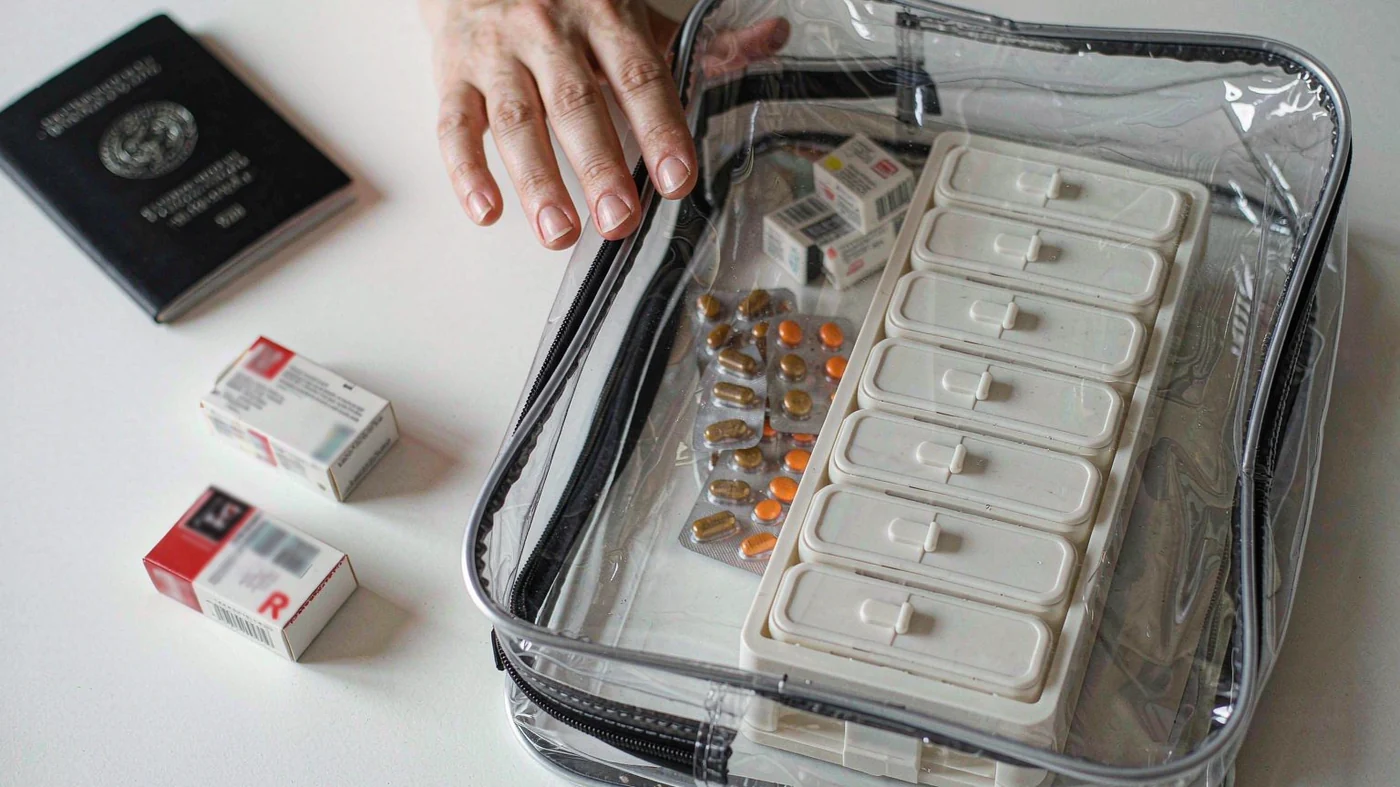
| Medicine type | Limit without Import Confirmation |
|---|---|
| Prescription drugs (including poisons and deadly poisons as classified in Japan) | Up to a one-month supply |
| External-use drugs that are not prescription, poison, or deadly poison | Up to 24 pieces per item |
| Injectable drugs | Up to a one-month supply, and only as a pre-filled syringe or self-injection kit |
| Other drugs and quasi-drugs | Up to a two-month supply |
A worked packing example
Suppose an ordinary, permitted prescription tablet is taken once daily. Carrying 90 tablets means carrying a 90-day supply, even for a two-week holiday, so the one-month exemption does not cover it. Write down the number of doses actually packed for each medicine, not just the length of the trip. This is a planning example, not a reported travel case; controlled medicines still require their own checks [1].
Check your drug category
Brand names differ by country. The same name can mean different active ingredients abroad, so the generic name on the label should be checked with the prescribing doctor or pharmacist.
Japan uses several control groups: general prescription medicines; psychotropics such as many sleep and anti-anxiety medicines; narcotics such as morphine, fentanyl, oxycodone, and codeine; stimulants’ raw materials such as lisdexamfetamine in Vyvanse; and stimulants such as amphetamine in Adderall — plus cannabis and opium controls [2].
Ask the prescribing doctor or pharmacist for the active ingredient, strength, and daily dose. Compare the ingredient with the Narcotics Control Department (NCD) guidance, and ask NCD about any uncertain classification before packing. A foreign prescription alone does not establish that a medicine is legal to import [2].
Pack within the limit
Original boxes with pharmacy labels travel best, along with a copy of the prescription. A short English letter from the doctor helps — generic names, strengths, daily doses, and the condition each drug treats. All of this belongs in carry-on luggage, where it stays available if customs asks.
For injectable medicines and their syringes, the one-month exemption applies only to pre-filled syringes or self-injection kits. Other arrangements need confirmation with MHLW rather than an assumption that the exemption applies [1]. Ask the pharmacist about the product’s storage requirements and the airline or departure airport about carrying needles and cooling materials; import permission does not settle aviation-security requirements.
Get the import certificate
If the amount of an ordinary medicine exceeds its allowance, obtain the Yunyu Kakunin-sho before leaving home and show it at customs. The trigger is the amount carried, not the length of the stay or the size printed on the original bottle [1].
Applications run online through the Ministry of Health, Labour and Welfare portal, which has processed personal imports since February 2023. After account registration, the form and documents are submitted there, and the regional bureau issues the certificate for download, with a copy sent to the registered email addresses [3].
Narcotics need separate permission
A general Import Confirmation does not cover narcotics such as morphine, fentanyl, oxycodone, or codeine, or stimulants’ raw materials such as lisdexamfetamine. These need advance permission from the Narcotics Control Department held before travel [2].
The application goes to the office covering the arrival airport — for different entry and departure cities, the arrival side controls. Complete files are due at least 14 days ahead, and last-minute submissions risk refusal [2].
Required documents include the import form, a medical certificate from the prescribing doctor, and package photos or equivalent papers identifying the product, name, and strength. The certificate must state the traveler’s name, current address, and the specific medical reason; vague wording such as “for personal use” or “for travel” is rejected. Every drug needs its dose and strength listed, with the doctor’s signature and an issue date within the last three months [2].
For these medicines, carry them yourself and show the permit at customs; do not mail them or entrust them to another traveler. If you will leave Japan with leftover narcotics or stimulants’ raw materials, NCD also instructs you to submit an export application. Arrange the return journey’s paperwork with the import application [2].
Application details worth checking
NCD says its email system cannot view HEIC photos: send package images as JPEG, PDF, or Word files. For attachments larger than 10 MB, split them across emails. Send a short follow-up without attachments to confirm receipt; sending an application is not proof that it arrived or that permission has been granted [2].
For the 2026–27 New Year only, NCD lists these earlier complete-file deadlines: 7 December 2026 for entry from 21 December 2026 to 4 January 2027; 14 December 2026 for entry from 5 to 11 January 2027; and 21 December 2026 for entry from 12 to 18 January 2027. Offices are closed from 29 December 2026 to 3 January 2027. Check the current notice for your own travel dates; these are not the general Import Confirmation deadlines [2].
Psychotropics
Psychotropics such as zolpidem, alprazolam, clonazepam, diazepam, methylphenidate, and buprenorphine have a separate quantity table linked from the NCD guidance, not the general allowance table above. Listed medicines in non-injection form at or below the NCD quantities need neither a doctor’s certificate nor permission under the Narcotics and Psychotropics Control Law. Above those quantities, or for injections, carry a certificate from the prescribing doctor identifying the illness, treatment need, medicines, doses, strengths, and quantities, with the doctor’s signature and issue date. For more than a one-month supply, NCD directs travelers to yakkan@mhlw.go.jp about the additional import requirements [2].
Medicines banned in Japan
A valid foreign prescription does not override a Japanese import ban. Amphetamine, the active ingredient in Adderall, is controlled as a stimulant under Japan’s Stimulants Control Act and cannot be imported, even for treatment [2].
Travelers taking it should discuss lawful alternatives with the prescribing doctor well before departure, and verify the replacement’s classification independently rather than assuming it is permitted.
Lisdexamfetamine in Vyvanse and similar brands is handled as a stimulants’ raw material and is importable only with the advance permission above [2]. Cannabis-derived products remain tightly restricted regardless of home-country legality. For uncertain products — including combination cold remedies — the Narcotics Control Department should be consulted before packing.
At the airport
Keep the medicines, prescriptions, and required certificates together so they are available for inspection. Show the Yunyu Kakunin-sho and any NCD import permit where required [1] [2]. Japan Customs lists prohibited drug categories and statutory exceptions; do not treat a foreign prescription as permission to bring a prohibited substance through the border [4].
Mailing medicines
Mailing is not a workaround for personal-import controls: check the applicable Import Confirmation requirements before arranging a shipment [1]. Narcotics and stimulants’ raw materials covered by NCD’s traveler procedure must travel with the patient, not by parcel or through another person [2].
Longer stays
If you may need a prescription in Japan, ask a local medical provider about availability before relying on a replacement. Do not assume that your exact medicine or a suitable alternative will be available. For a clinic visit, prepare the medicine list and an English referral letter covering the diagnosis and current regimen. If the trip involves regenerative-medicine care, the clinic appointment and physician-review process explains that separate care pathway; it is not an import-permission service.
Travelers visiting Japan for that care can keep the medicine list with the records described in the medical travel guide for stem cell treatment in Japan. Do not stop, swap, or ration prescribed medicines to stretch a supply; ask the prescribing doctor to plan any changes.
Pre-travel checklist
- Full product list: generic name, strength, dose, schedule, and reason for use, including over-the-counter items and supplements.
- Japanese category for each ingredient, confirmed with the doctor or pharmacist; narcotic, psychotropic, stimulant-related, injectable, or cannabis-derived items flagged.
- Days of supply per drug, measured against the one-month (prescription) and two-month (other drugs and quasi-drugs) lines.
- For psychotropics, the separate NCD quantity table and any doctor’s certificate requirement checked.
- Import Confirmation applied for online when over the limit; Narcotics Control Department permission for narcotics and stimulants’ raw materials at least 14 days ahead [3] [2].
- Original labeled containers, prescriptions, the doctor’s letter, and all certificates packed in carry-on luggage.
- Ministry and Narcotics Control Department pages re-checked shortly before departure, since forms, deadlines, and holiday schedules change.
Planning a clinic visit in Japan? Contact the patient support team about appointment preparation and sharing your medicine list. Import eligibility and permits must be confirmed with MHLW or NCD, not the support team.
Contact UsThis is general information, not personal medical or legal advice; see the medical disclaimer. Confirm uncertain ingredients, quantities, and documents with the prescribing doctor and the relevant Japanese authority before departure.




