
Yes. Exosome treatments are intended to be cell-free: they deliver particles released by cells rather than living cells themselves. Exosomes cannot divide or become new tissue. But the label does not establish that a particular vial has been tested for residual cells, nor does it prove purity, safety, or benefit.
The evidence behind that limit is concrete. The FDA’s content, current as of 9 April 2024, states there are zero FDA-approved exosome products.Consumer alert regenerative medicine products including stem cells and exosomes In a 2024 randomized, triple-blind knee trial, 31 adults joined and 29 finished the six-month analysis.S12891 024 07979 w A single placental EV shot showed no clear edge over saline at two or six months.S12891 024 07979 w Japan’s July 2024 health-ministry notice covers stem-cell culture supernatant and exosome-related products and says their use needs close safety attention.001281987.pdf A “cell-free” label tells you where to look next. It does not prove a vial is pure, safe, or effective.
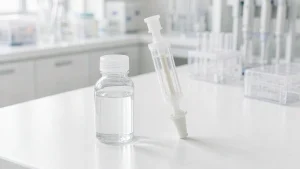
What cell-free does and does not mean
If your question is really “does cell-free mean the vial holds nothing but exosomes,” the answer is no. The term means the treatment is not designed to place living cells in your body. The vial may still hold other material and carry risk. It also acts differently from cell therapy.
Blood stem-cell transplant shows the difference. It is used for selected blood cancers and other blood or immune disorders, not for general rejuvenation. Healthy blood-forming cells go into a vein. They travel to the marrow. They rebuild blood production after strong chemo or radiation. It carries real risks: infection, bleeding, and graft-versus-host disease with donor cells.Stem cell transplant
An exosome shot cannot do that work. It cannot replace marrow. It cannot make red cells, white cells, or platelets. It cannot grow tissue by dividing. Scientists are testing whether signals from vesicles change nearby cell behavior. That research is still about possible mechanisms. It does not prove a shot helps a specific disease.
Why exosomes count as cell-free
Stem cells are alive. They can copy themselves under the right conditions. They can mature within the limits of their type. They carry a nucleus, DNA, organelles, and cytoplasm.
EV is the broader term for a lipid-bilayer particle a cell releases. The particle cannot copy itself. Exosomes are one subtype. They form through the cell’s endosomal path. Current global guidance says to write “EV” unless tests prove the exact origin.Jev2.12404 Size alone or a nice label cannot prove a particle is truly an exosome.Jev2.12404
| Feature | Living stem cells | Exosomes / small EVs |
|---|---|---|
| What they are | Living cells capable of self-renewal and specialization | Membrane-enclosed particles released by cells |
| Can they divide? | Yes, under suitable conditions | No independent replication |
| Can they become another cell type? | Yes, within the limits of the cell type | No |
| What they contain | Nucleus, DNA, organelles, cytoplasm | Proteins, lipids, RNA such as mRNA and miRNA; no functional nucleus |
| Where they come from | Sources include bone marrow, fat, and cord blood | Many cell types, including stem cells |
| Studied role | Blood-forming cells can restore blood production; some other cell products are studied mainly for immune or signaling effects | Cell communication, biomarker research, delivery research, and experimental therapies |
The table covers the biology behind the cell-free answer alone, not which option is better. Proof for a living-cell therapy does not prove an exosome product works. And lab or animal results on vesicles do not prove a patient will benefit.
What stem-cell-derived means on a cell-free label
Many vials say “stem cell-derived exosomes” or “MSC-derived EVs.” If you are asking whether that wording proves the vial is cell-free, it does not. The wording names the source of the particles. It does not mean living stem cells sit in the vial. It also says nothing about what else made it into the final liquid.
After cells grow in a dish, the liquid around them is called conditioned medium. It can hold secreted proteins, cytokines, growth factors, matrix pieces, and vesicles, plus leftover medium ingredients. A seller may offer the whole liquid, an EV-enriched part, or a more narrowly cleaned vesicle mix. The cleaning method — centrifugation, filtration, size-exclusion separation, or ultrafiltration — decides what stays and what goes.
Particle concentration and total protein are measurements, not proof of exosome identity or a clinically effective dose. Animal serum can introduce its own vesicles and proteins, making characterization harder.Jev2.12404 Ask which culture ingredients were used, what the separation process removes, and which tests apply to the batch offered. A description of a cell processing center is not a substitute for that product’s test results.
If it has no cells, why can it still harm you
A genuinely cell-free preparation cannot engraft or divide as transplanted living cells can. That distinction does not establish overall safety. Manufacturing contamination, residual reagents, microbes or endotoxin, incorrect labeling, and an unsuitable dose or route remain concerns.
Questions about treatment safety in Japan should therefore address the actual product and procedure, not just the absence of cells. Ask who manages adverse reactions and what care could be delayed if you choose an experimental intervention.
Does cell-free mean unregulated
United States
No. In the US, exosome products intended to treat disease are regulated as drugs and biological products and require FDA approval for marketing. The FDA consumer alert, with content current as of 9 April 2024, states that no exosome products were FDA-approved.Consumer alert regenerative medicine products including stem cells and exosomes This dated statement should not be read as a new approval-status check. The FDA also warns against unsubstantiated treatment claims and the claim that exosome products fall outside drug regulation.Public safety notification exosome products
Nebraska showed the stakes in 2019, when people suffered serious harms after unapproved products sold as containing exosomes.Public safety notification exosome products If you consider such a product in the US, ask whether FDA review applies. Ask for the Investigational New Drug number and any FDA letters where relevant. Read the trial consent form and review-board details with care. And report any suspected bad reaction. Outside the US, the FDA notes it often holds little detail on foreign sites, so local rules decide.
Japan
A clinic filing under regenerative-medicine rules is not the same as a product approval. A filed plan, a consent form, or a registration entry does not establish that an exosome preparation is effective for a specific disease.
Japan’s Ministry of Health, Labour and Welfare issued its notice on 31 July 2024. At that time, it stated that no medicines using the covered stem-cell culture supernatant or cell secretions, including EVs, had demonstrated efficacy and safety and obtained pharmaceutical approval for marketing, including overseas. It urged particular attention to safety under the treating physician’s or dentist’s responsibility.001281987.pdf
Do not assume that a clinic’s regenerative-medicine registration or provision plan covers a proposed cell-free product. Ask which legal framework applies to that exact preparation and procedure, and request the relevant documents. The notice itself is neither a product approval nor evidence of benefit.
Does cell-free mean proven to work
No. Cell-free describes composition, not effectiveness. Laboratory and animal findings can suggest mechanisms, but they do not establish benefit in people. Human evidence must match the preparation, disease, dose, and route being proposed.
A 2024 randomized, triple-blind trial in Iran studied knee osteoarthritis. It enrolled 31 adults with disease in both knees (Kellgren–Lawrence grade 2–3); 29 were included in the final analysis. These were 29 people, not 58 independent participants: each person contributed a treated knee and a control knee.S12891 024 07979 w
One knee received a single intra-articular injection of placental mesenchymal stromal cell-derived EVs: 5 mL at 7 × 10⁹ particles/mL. The other received 5 mL saline. Pain and function scores showed no statistically significant between-group difference at two or six months. MRI, assessed at baseline and six months rather than at two months, also showed no statistically significant between-group difference.S12891 024 07979 w
Four of the 31 participants, about 13%, reported moderate pain with mild warmth that improved within 48 hours with cold compresses and paracetamol. The authors reported no systemic complications or severe local reactions. These patient-level reports should not be read as a precise EV-specific adverse-event rate, because each participant received both interventions.S12891 024 07979 w
This small trial does not establish long-term safety or exclude rare harms. It also cannot determine whether other EV preparations work for other conditions. A nonsignificant result is not proof that two treatments are equivalent. Trial registration and publication alone do not establish effectiveness.
How to check a cell-free claim
If your real question is “is this vial both cell-free and worth considering,” bring these eight questions to the clinic and ask for written answers with papers, not brochures alone. When you compare offers, read the paperwork line by line: if a brochure says “exosomes” while the consent form or product sheet describes conditioned medium or an EV-enriched fraction, use these questions to pin down which liquid is actually proposed.
- What exactly is in the vial: whole conditioned medium, an EV-enriched fraction, or a characterized vesicle preparation?
- Which source cells were used, and what does “stem cell-derived” refer to in this product?
- How were living cells and debris removed? What batch-specific tests assess residual intact cells, identity, sterility, endotoxin, residual DNA, and composition, and what are their detection limits?
- What dose is proposed, by what route, how often, and what follow-up is planned?
- Is this care, a registered clinical trial, or an experimental or private-clinic service? What is the trial phase, sample size, endpoints, and adverse-event plan?
- Which legal framework applies to this exact product and procedure? If a Japanese provision plan or another regulatory document is cited, does it actually cover the proposed intervention?
- What are the known and possible risks, including infection, immune or local reactions, contamination, and delay of standard care?
- What alternatives exist, including standard care and watchful waiting, and what happens if treatment is declined?
Treat promises built on particle counts, before-and-after photos, glowing stories, or long disease lists with care. None of that replaces hard proof for your disease, your group, your route, and real follow-up.
A practical paperwork check
Suppose a brochure says “purified exosomes,” but the product sheet says “conditioned medium” and lists only a particle count. Those documents do not establish that the vial contains only exosomes or that residual cells were assessed. Ask the clinic to reconcile the descriptions and provide the batch identifier, separation method, and relevant test reports. A residual-DNA result is not the same measurement as a test for intact living cells.
This is an illustrative document-checking scenario, not a patient case or a report of clinical experience. It can help you identify missing information; it cannot authenticate a vial or replace advice from a qualified clinician.
Unsure what is actually in the vial you were offered?
Contact the support team with questions about the product information you have received. Do not send identifiable medical records through a general inquiry form. Discuss medical decisions with a qualified clinician.
Bottom line
Yes, exosome treatments are cell-free in the biological sense. Exosomes are not cells. They cannot divide or grow into tissue. But that short answer does not settle safety or benefit.
Before deciding, separate three questions: were residual cells assessed, was product quality checked, and is there credible human evidence for your condition? Request batch-specific documents and discuss standard-care alternatives with your clinician. Neither a cell-free label nor a clinic registration answers all three.
References
- FDA. Consumer Alert on Regenerative Medicine Products Including Stem Cells and Exosomes. Content current as of 9 April 2024. https://www.fda.gov/vaccines-blood-biologics/consumers-biologics/consumer-alert-regenerative-medicine-products-including-stem-cells-and-exosomes
- Placental MSC-derived extracellular vesicles versus saline in bilateral knee osteoarthritis: 2024 randomized triple-blind trial, 31 enrolled and 29 analyzed. https://doi.org/10.1186/s12891-024-07979-w
- Japan Ministry of Health, Labour and Welfare. Notice on stem-cell culture supernatant and exosome-related products, July 2024. https://www.mhlw.go.jp/content/001281987.pdf
- National Cancer Institute. Stem Cell Transplants in Cancer Treatment. https://www.cancer.gov/about-cancer/treatment/types/stem-cell-transplant
- Welsh et al. Minimal information for studies of extracellular vesicles 2023 (MISEV2023). Journal of Extracellular Vesicles. https://doi.org/10.1002/jev2.12404
- FDA. Public Safety Notification on Exosome Products, 6 December 2019. https://www.fda.gov/vaccines-blood-biologics/safety-availability-biologics/public-safety-notification-exosome-products




