Stem cell supernatants are cell-free liquids collected from stem cell cultures; stem cell treatments contain living cells. Living stem cells can renew themselves and develop into particular cell types, depending on their source. A properly cell-depleted supernatant cannot divide, engraft, or become new tissue. It may contain substances released by the cells, but it is not a substitute for them, and evidence for a cell treatment does not establish that its supernatant works.
Big numbers mislead easily. In Japan, 6,743 treatment provision plans had been filed under the regenerative medicine framework as of 30 June 2026 001590173.pdf. That number tracks filings, not cures. In the United States, the regulator says no exosome product has FDA approval Consumer alert regenerative medicine products including stem cells and exosomes. The difference comes down to four things: what each one contains, what each one can do, what proof backs each one, and what each one risks. It is general information only and is not personal medical advice.
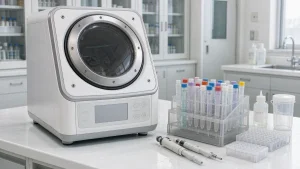
Living Stem Cells
Blood-forming stem cell transplantation is established care for selected blood cancers, blood disorders, and immune disorders. Transplanted blood-forming cells can restore blood production. This is different from using mesenchymal stromal cells, often abbreviated MSCs, or cell-free products for other conditions.
In December 2024, the FDA approved Ryoncil, a donor bone-marrow-derived MSC therapy, for steroid-refractory acute graft-versus-host disease in children aged 2 months and older. This is a serious complication of donor blood stem cell transplantation, not a general indication for tissue regeneration Fda approves first mesenchymal stromal cell therapy treat steroid refractory acute graft versus host.
The supporting multicenter, single-arm study included 54 children. They initially received intravenous infusions twice weekly for four weeks; some received additional infusions. At day 28, 16 children (30%) had a complete response and 22 (41%) had a partial response. There was no concurrent control group, and these response rates are not long-term cure rates. Common adverse reactions included infections, fever, and bleeding Fda approves first mesenchymal stromal cell therapy treat steroid refractory acute graft versus host.
That approval applies to one product and indication. It does not establish benefit for other MSC products, diseases, supernatants, or exosomes. For an offer outside an established indication, ask whether it is an approved medicine, a clinical trial, or a private clinic service. Trial data alone do not make a product approved, and US regulatory status does not determine its legal status in Japan.
Cell-Free Supernatants
In this context, culture supernatant usually means conditioned medium collected after cultured cells have been removed. It includes the culture medium itself as well as material released by the cells. Removing cells does not automatically produce a purified medicine or prove the liquid is sterile.
Conditioned medium can contain proteins, nucleic acids, lipids, and extracellular vesicles. A University of Milan-affiliated laboratory study compared adipose-derived stromal cell conditioned medium with isolated vesicles in cultured human cartilage cells. The preparations produced different laboratory effects; the study did not test injections in patients S13287 020 02035 5.
No Fixed Recipe
The cell source, culture medium, collection time, and processing steps help define the preparation. Two products called “stem cell supernatant” are not necessarily equivalent. Ask for product identity, batch-release criteria, and evidence of consistency rather than assuming a shared name means a shared effect.
Related Terms Are Not Interchangeable
The secretome is the material cells release. Conditioned medium is the liquid containing that material alongside medium ingredients. Extracellular vesicles are membrane-enclosed particles released by cells; exosomes are a subtype, not a synonym for every vesicle or for the whole supernatant. A preparation may contain vesicles, but its name alone does not establish their identity, purity, or quantity.
No Living-Cell Abilities
Without living cells, a supernatant cannot itself become cartilage, nerve, or muscle. Researchers study whether its contents affect recipient cells. Biological activity is not the same as a demonstrated improvement in a patient’s pain, function, or disease course.
Cells vs. Supernatants at a Glance
| Feature | Living stem cells | Stem cell supernatant |
|---|---|---|
| What it is | Living cells | Cell-free liquid collected after cell culture |
| Contains living cells? | Yes | No, when properly separated |
| Can it divide or form tissue? | Depends on cell type, within biological limits | No |
| Main contents | Living cells in a product-specific carrier solution | Culture medium and released material; may contain proteins and vesicles |
| How it is made | Donation or collection, processing, viability and sterility checks | Cell culture, medium collection, cell removal, filtration and storage steps |
| Storage and handling | Must preserve cell viability under validated conditions | Needs validated storage and stability testing, even without living cells |
| How effects are proposed to occur | Depends on the therapy; may involve engraftment or signaling | Through the collected material, if effective; no living cells are added |
| What evidence would be needed | Trials in a defined disease, population, dose, route, and follow-up period | The same: trials in a defined condition, not laboratory or animal findings alone |
| Key safety considerations | Procedure and product-specific risks; graft-versus-host disease is a risk of donor blood stem cell transplantation, not every cell therapy | Contamination, reactions to ingredients, dose uncertainty, and consistency; cell-free does not mean risk-free |
Proposed Effects vs. Proof
Both living cells and cell-free preparations can act through signaling; engraftment is not required for every cell therapy to have an effect. Conversely, a liquid that changes cell behavior in a laboratory has not thereby been shown to help patients. The relevant evidence is human research on the actual preparation, diagnosis, dose, route, comparator, and follow-up period.
A result with living cells does not establish the effectiveness of their supernatant. A trial registration establishes that a study was registered, not that it succeeded. Check the published results and whether they apply to the product and condition being offered.
What Is Proven for Each One
Evidence is product- and indication-specific, not a contest in which all cells are proven and all liquids are unproven. Established blood stem cell transplantation and Ryoncil’s narrow approval do not validate supernatant injections for joints, skin, hair, fatigue, or rejuvenation.
Japan’s health ministry reported 6,743 filed treatment provision plans as of 30 June 2026: 4,272 Class 3, 2,463 Class 2, and 8 Class 1, with 85 research plans listed separately 001590173.pdf. This is a framework-wide filing count, not a count of supernatant treatments, approved medicines, or successful outcomes.
The FDA consumer alert, marked current as of April 2024 and accessed on 5 November 2026, states that no exosome products are FDA-approved Consumer alert regenerative medicine products including stem cells and exosomes. Its older statement limiting approved stem cell products to cord-blood products predates Ryoncil’s December 2024 approval and should not be treated as a complete current approval list. Check the exact product and indication rather than relying on a broad category claim.
A Practical Document Check
A concrete example appears on this site’s registration and compliance page. It lists clinic-reported treatment-plan identifiers PB3250148 through PB3250151 and facility identifier FC3250034, while explicitly distinguishing those records from the support team’s qualifications and from proof of efficacy. This is a document-reading example, not a report of patient outcomes or independent confirmation of the records’ current official status.
If a consultation offers supernatant but the paperwork describes a living-cell procedure, ask the provider to explain which record, legal route, and consent document apply to the actual liquid. Do not assume that a cell-processing facility number covers every product made there. Keep that regulatory question separate from whether human trials show benefit for your diagnosis.
Safety and Quality Differences
Shared Concerns
Both paths demand sterile production, donor screening where human material is used, and checks for contamination. Allergic and inflammatory reactions show up with either type.
Living-Cell Concerns
Risks depend on the cell type, donor relationship, processing, and administration route. Graft-versus-host disease is associated with donor blood stem cell transplantation; it should not be presented as a universal risk of MSC treatment. For Ryoncil specifically, the FDA warns about hypersensitivity, infusion reactions, infectious-agent transmission, and ectopic tissue formation Fda approves first mesenchymal stromal cell therapy treat steroid refractory acute graft versus host.
Supernatant Concerns
A genuinely cell-free product cannot engraft as living cells, but its ingredients can still cause reactions. Ask how the final preparation is tested for contamination, residual culture ingredients, identity, and biological activity. A protein concentration or particle count alone is not evidence of an effective clinical dose.
Neither liquid storage nor freeze-drying automatically makes a preparation stable, safe, or easy to ship. The manufacturer must establish suitable conditions for that product. There is no basis here for declaring all supernatants safer than all cell treatments.
Questions to Ask Your Provider
- What exactly would I receive, living cells or a cell-free liquid, and what is the cell source?
- For my diagnosis and stage, what human trials of this specific product and route exist, how many people were studied, and how long were they followed?
- What were the measured outcomes and the reported side effects?
- Is this an approved medicine for my condition, a registered clinical study, or a private clinic service?
- How is the product tested for identity, sterility, and consistency, and what happens if I have a reaction?
- What are the alternatives, including not having the intervention, and what will follow-up involve?
Solid providers give straight answers, keep established care apart from experimental offers, and write down the plan, costs, and follow-up. Treat grand regeneration promises, comparisons borrowed from unrelated studies, or rush tactics as a cue to stop. Ask a separate doctor for a second view.
Considering cell-based care in Japan? Send your diagnosis and questions for an initial review before you travel.
The Bottom Line
The difference is living cells versus a cell-free preparation, not effective versus ineffective or risky versus safe. Ryoncil’s approval drew on a 54-child study for one specific complication; it does not validate a supernatant. Before deciding, identify the exact product, ask for human evidence relevant to your condition, and establish whether the offer is an approved medicine, a clinical trial, or a private service. Do not delay established care while investigating an experimental option.
References
- Ministry of Health, Labour and Welfare, Japan. Provision-status table of regenerative medicine treatment plans, national data as of 30 June 2026. Accessed 5 November 2026. https://www.mhlw.go.jp/content/001590173.pdf
- U.S. Food and Drug Administration. Consumer alert on regenerative medicine products, including stem cells and exosomes. Page current as of 9 April 2024. Accessed 5 November 2026. https://www.fda.gov/vaccines-blood-biologics/consumers-biologics/consumer-alert-regenerative-medicine-products-including-stem-cells-and-exosomes
- U.S. Food and Drug Administration. Press release: FDA approves first mesenchymal stromal cell therapy for steroid-refractory acute graft-versus-host disease, 18 December 2024. Accessed 5 November 2026. https://www.fda.gov/news-events/press-announcements/fda-approves-first-mesenchymal-stromal-cell-therapy-treat-steroid-refractory-acute-graft-versus-host
- Giannasi C, Niada S, Magagnotti C, et al. Comparison of two ASC-derived therapeutics in an in vitro OA model: secretome versus extracellular vesicles. Stem Cell Research & Therapy. 2020;11:521. Laboratory study, not a patient treatment trial. Accessed 5 November 2026. https://doi.org/10.1186/s13287-020-02035-5